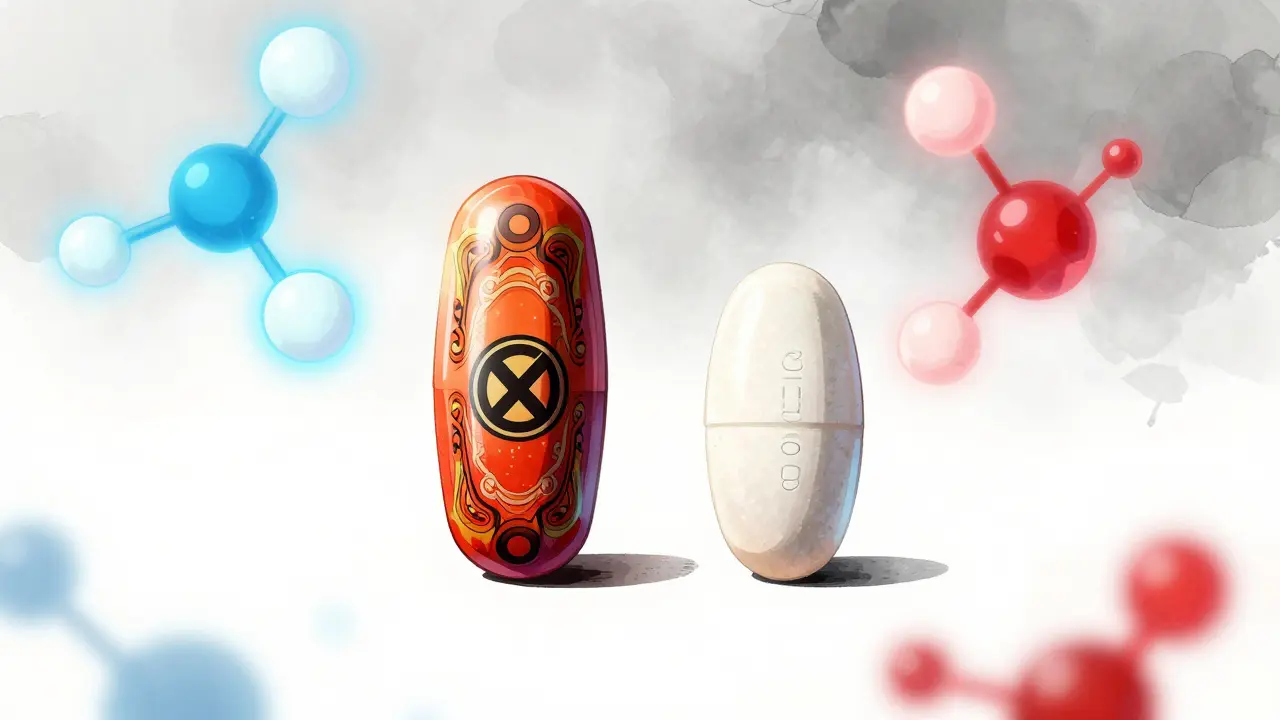
When you pick up a prescription, you might see two pills that look completely different-one is a big, colorful tablet with a fancy name, the other is a small, plain white pill with a letter and number stamped on it. The price? One costs $150. The other, $4. You might wonder: is the cheaper one just a copy? A fake? A watered-down version? The short answer: no. Generic drugs aren’t copies in the way you think. They’re scientifically proven to work the same way.
What exactly is a generic drug?
A generic drug is not a knockoff. It’s not a copycat. It’s not a cheaper version with less of the good stuff. A generic drug contains the exact same active ingredient as the brand-name version, in the same strength, same dosage form (tablet, capsule, injection), and same way of being taken (by mouth, under the tongue, through the skin). The FDA requires that it delivers the same amount of medicine into your bloodstream at the same speed as the original. That’s called bioequivalence.Think of it like two identical engines-one built by Toyota, the other by a parts supplier that follows Toyota’s exact blueprints. Same fuel, same power, same performance. The outside might look different, the paint color might be different, but under the hood, it’s the same machine.
The FDA doesn’t approve generics based on trust. They demand proof. Manufacturers must run tests showing that the generic drug’s absorption rate in the body falls within 80% to 125% of the brand-name drug’s. That’s not a guess. That’s a strict scientific standard. In fact, testing shows that generics contain, on average, 99.2% of the active ingredient listed on the label. Not 80%. Not 90%. Nearly all of it.
Why do they look and taste different?
You might notice your generic pill is smaller, white, or tastes slightly bitter compared to the brand-name version. That’s because the inactive ingredients are different. These are the fillers, dyes, binders, and flavorings that don’t treat your condition but help the pill hold its shape, dissolve properly, or just look nicer.Brand-name companies trademark their pills. They want you to recognize them. So they use specific colors, shapes, and coatings. Generic makers can’t copy that. The law says they must make their pills look different to avoid confusion. But that’s it. The medicine inside? Identical.
Some people report feeling different on a generic. Maybe they get a headache, or their stomach feels off. That’s usually not because the active ingredient changed. It’s because of a new filler-maybe a dye they’re sensitive to, or a different type of starch. These reactions are rare, and they’re not about effectiveness. They’re about personal tolerance to something that doesn’t treat your disease.
Are generics as safe and effective?
Yes. The FDA says it plainly: “Generic drugs work the same as brand-name drugs in the same way and provide the same benefit(s).” That’s not marketing speak. That’s their official position, backed by decades of data.Between 2018 and 2022, the FDA reviewed over 1,800 reports of possible problems with generic drugs. After investigation, only 5.5 cases per year were confirmed as actual bioequivalence failures. That’s less than 0.3% of all reports. For comparison, you’re more likely to be struck by lightning than to have a generic drug fail because it didn’t work.
Studies across millions of patients show the same thing. On Drugs.com, 82% of users say generics work just as well as brand names. A Kaiser Family Foundation survey found that 89% of people who got generics were satisfied with them. And in states that require pharmacists to substitute generics unless told otherwise, prescription costs dropped by over 12%-with no drop in health outcomes.
Even doctors who used to prescribe brand names are switching. A 2022 Harvard study found that patients who couldn’t afford brand-name drugs were 25% more likely to skip doses. When they switched to generics, that number dropped to 8%. That’s not just savings. That’s better health.
What about those scary stories?
You’ve probably heard stories: “My mom had a seizure after switching to generic epilepsy meds.” “My thyroid stopped working after the pharmacy changed my pill.” These stories are real-and they’re why people worry.But here’s the nuance: they’re not about generics being weak or fake. They’re about narrow therapeutic index (NTI) drugs. These are medications where even a tiny change in blood levels can cause big problems. Think blood thinners like warfarin, thyroid meds like levothyroxine, or seizure drugs like phenytoin.
For these drugs, the FDA requires even stricter testing. And yes, some patients do better staying on the same brand. But that’s not because generics are inferior. It’s because switching between any two formulations-even two different brand-name versions-can cause fluctuations in blood levels. That’s why doctors often recommend staying on the same version, generic or not.
Studies show that 96% of non-NTI drugs (like statins, blood pressure meds, and antidepressants) work perfectly fine when switched to generics. For NTI drugs, the success rate is still 92%, but doctors monitor more closely. That’s not a failure of generics. That’s good medical practice.
Why are generics so much cheaper?
Brand-name drugs cost a fortune because the company had to spend years and hundreds of millions developing the drug, running clinical trials, and marketing it. Once the patent expires (usually after 20 years), other companies can make the same drug. They don’t need to repeat those expensive trials. They just need to prove their version works the same way.That’s the whole point of the 1984 Hatch-Waxman Act. It created a faster, cheaper path for generics to enter the market. The result? Today, 90% of prescriptions in the U.S. are filled with generics-but they make up only 23% of total drug spending. The average generic costs 85% less than the brand-name version. GoodRx data shows generics average $4.27 per prescription. The brand? $61.85.
That’s not a trick. That’s competition. When five companies start making the same pill, the price drops. And that’s why millions of people can afford their medicine now.
Can you ask for the brand name instead?
Yes. In 49 states, pharmacists can substitute a generic unless the doctor says “dispense as written.” In 28 states, you can even ask for the brand-name drug and pay the generic price if the doctor approves it. If you feel better on one version, tell your doctor. They can write a note to prevent automatic substitution.But don’t assume the brand is better. A Brown University survey found that 65% of patients ask for brand-name drugs because they think generics are weaker. That’s a myth. And 43% believe generics contain only 20-80% of the active ingredient. The truth? They contain nearly all of it.
What’s changing in the world of generics?
The FDA is working to speed up approvals. In 2018, there were over 4,200 generic applications waiting. Now, thanks to new funding and processes, they’re aiming to cut approval time to 10 months by 2027. They’re also focusing on harder-to-copy drugs-like inhalers, injectables, and topical creams-where matching the exact behavior in the body is trickier.Biosimilars (generic versions of complex biologic drugs like Humira or Enbrel) are starting to appear. They’re not exact copies like traditional generics, but they’re proven to work just as well. By 2027, they could make up 15% of the market.
Medicare Part D now automatically switches patients to generics unless it’s medically unsafe. That’s projected to save $156 billion over ten years.
What should you do?
If you’re on a generic drug and it’s working? Don’t change a thing. If you’re on a brand-name drug and it’s expensive? Ask your doctor if a generic is available. If you’re switching and notice something off? Talk to your pharmacist. They can tell you if it’s a new filler, or if you’re on an NTI drug that needs extra monitoring.Don’t let the color, shape, or price fool you. The science is clear: generic drugs are not copies. They’re proven, safe, and just as effective. The only real difference? Your wallet.

Brian Furnell
December 22, 2025 AT 04:22Let’s be real-bioequivalence isn’t just a buzzword; it’s a statistically rigorous framework validated by thousands of pharmacokinetic studies. The 80–125% AUC and Cmax range? That’s not a loophole. That’s the FDA’s way of saying ‘same therapeutic effect, different packaging.’ And the 99.2% active ingredient fidelity? That’s tighter than most brand-name batch tolerances. We’re talking pharmaceutical precision, not corner-store knockoffs.
Siobhan K.
December 22, 2025 AT 20:16So let me get this straight-the color change is illegal, but the active ingredient being identical is somehow suspicious? The system rewards branding over biology, and we’re supposed to be shocked when people distrust the pill because it doesn’t look like the one in the TV ad?
Orlando Marquez Jr
December 23, 2025 AT 13:14It is of considerable note that the Hatch-Waxman Act of 1984 established a regulatory pathway that has significantly enhanced pharmaceutical accessibility without compromising therapeutic integrity. The empirical data, as cited by the FDA and corroborated by peer-reviewed longitudinal studies, substantiates the clinical equivalence of generic formulations across the vast majority of therapeutic classes.
Jackie Be
December 24, 2025 AT 15:20my doc switched me to generic lisinopril and i swear my blood pressure went nuts for a week then settled back down-turns out the new filler gave me mild acid reflux not the drug itself. so yeah it works same but sometimes your body just hates the new coating lol
Jon Paramore
December 26, 2025 AT 06:04NTI drugs require tighter bioequivalence margins-sometimes ±5% instead of ±20%. The FDA’s 2021 guidance for levothyroxine specifically mandates within-subject variability testing. Most generic failures are due to formulation inconsistencies, not active ingredient deficiency. This is why pharmacists track batch numbers for these meds.
Swapneel Mehta
December 28, 2025 AT 00:56Back home in India, generics are the only option for most people. I’ve seen grandparents on generic metformin for 15 years-no issues. The fear isn’t about science, it’s about not being told the truth. We need more transparency, not more stigma.
Cameron Hoover
December 30, 2025 AT 00:48I used to think generics were cheap because they were low quality. Then I saw my cousin’s insulin bill drop from $1,200 to $40. He’s alive today because of it. Sometimes the truth is just… cheaper.
Jason Silva
December 31, 2025 AT 19:55EVERYONE knows the big pharma companies pay the FDA to delay generics. They even bribe pharmacists to not switch. Look at the lawsuits-there’s a whole shadow system keeping prices high. The 85% cheaper stat? That’s the tip of the iceberg. They’re lying to you. 🤫💊
mukesh matav
January 2, 2026 AT 07:08I have no opinion on generics. I just take what the pharmacy gives me. If it works, I don’t ask questions. If it doesn’t, I talk to my doctor. Simple.
Peggy Adams
January 2, 2026 AT 12:28generic = government approved placebo? i mean why would anyone trust a white pill with no logo? they probably just grind up aspirin and call it a day
Sarah Williams
January 4, 2026 AT 11:36My mom’s on generic warfarin. She’s been stable for 3 years. Her INR’s perfect. No seizures. No strokes. Just savings. Don’t let fear cost you your health.
Theo Newbold
January 6, 2026 AT 10:57Let’s cut through the PR: the FDA’s 0.3% failure rate is statistically insignificant because they only investigate complaints that are filed. Most people don’t report. The real failure rate? Probably 10x higher. And the bioequivalence testing? All done by the generic manufacturers themselves. Conflict of interest much?