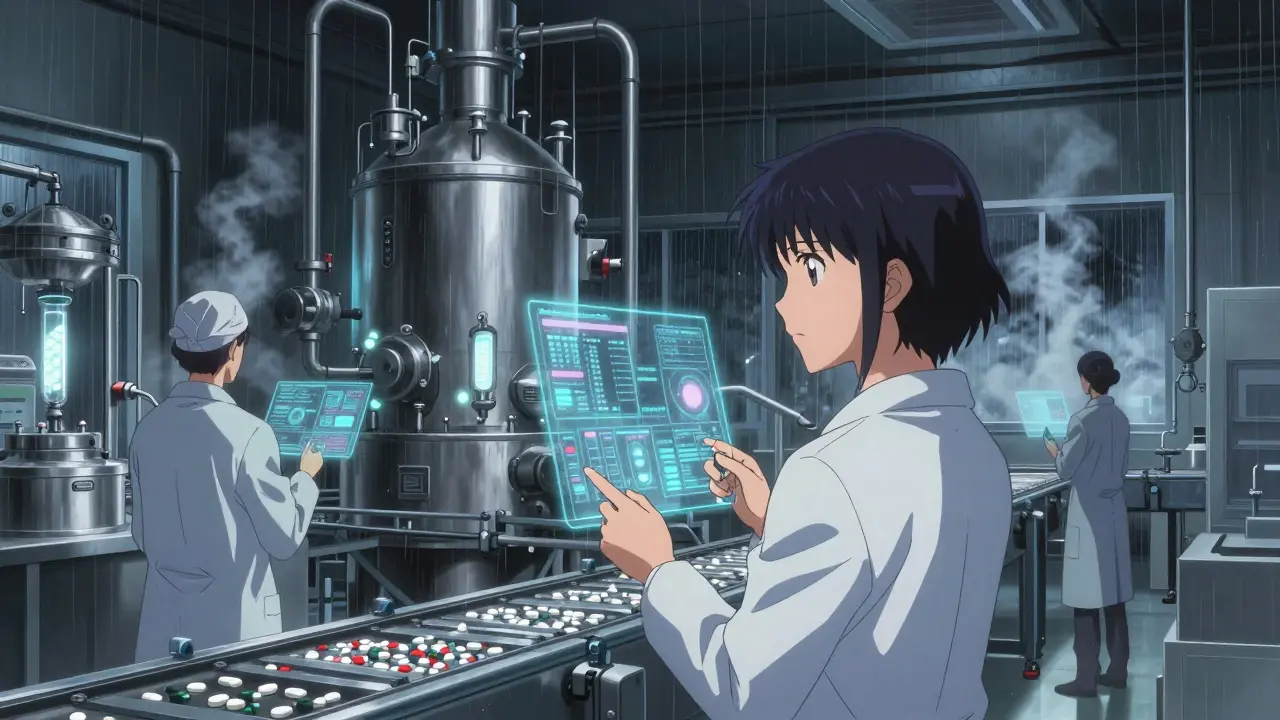
When you pick up a generic pill at the pharmacy, you expect it to work just like the brand-name version. That’s not luck. It’s because the FDA enforces strict Good Manufacturing Practices - known as CGMP - to make sure every generic drug is safe, effective, and consistent. These rules aren’t suggestions. They’re legally binding standards that every manufacturer, whether in Ohio or India, must follow to sell drugs in the U.S.
What Exactly Is CGMP?
CGMP stands for Current Good Manufacturing Practices. The "current" part is critical. It means manufacturers can’t rely on old methods or outdated equipment. They must use modern technology and up-to-date procedures to control every step of drug production - from raw ingredients to the final pill in the bottle. The FDA’s CGMP rules are written into federal law under 21 CFR Parts 210 and 211. These aren’t vague guidelines. They’re detailed, technical requirements covering everything from who can touch the medicine to how the air in the factory is filtered. The goal? Prevent contamination, mix-ups, and errors that could make a drug ineffective or dangerous. For generic drugs, CGMP is non-negotiable. The FDA doesn’t treat generics as second-class products. A generic metformin tablet must meet the same quality standards as the brand-name version. That’s why every Abbreviated New Drug Application (ANDA) submitted to the FDA includes a full review of the manufacturer’s CGMP compliance.Key Areas of FDA CGMP Requirements
CGMP covers every phase of manufacturing. Here’s where the rules hit hardest:- Personnel: Everyone involved - from chemists to cleaners - must be trained and qualified. Training records must be kept. No exceptions.
- Facilities: Cleanrooms must control temperature, humidity, and airborne particles. Airflow patterns are tested. Surfaces must be non-shedding and easy to clean.
- Equipment: All machines used in production must be calibrated and maintained. Maintenance logs are reviewed during inspections. A dirty or broken mixer? That’s a violation.
- Components: Every batch of active ingredient must be tested before use. Suppliers aren’t trusted blindly. The FDA requires proof of identity, strength, purity, and quality.
- Production Controls: Every step in making the drug must be validated. That means proving, with data, that the process consistently produces the same result. For most products, industry practice uses three consecutive successful batches to prove this.
- Packaging and Labeling: Labels must be verified to prevent mix-ups. A wrong label on a blood pressure pill can kill someone.
- Laboratory Controls: Finished products are tested for potency, dissolution, and impurities. Stability testing ensures the drug won’t break down before its expiration date.
- Records: Every action, every test, every adjustment must be written down. Records must be kept for at least one year after the product expires. Electronic records must follow 21 CFR Part 11 rules - including audit trails that can’t be deleted.
Why Does This Matter for Generic Drugs?
Generic drugs make up 90% of all prescriptions filled in the U.S. In 2022, Americans spent $105 billion on them. That’s huge. But with volume comes risk. If one manufacturer cuts corners, the whole system loses trust. CGMP levels the playing field. A small generic company in Alabama has to meet the same standards as a giant like Teva or Sandoz. That’s why the FDA inspects both domestic and foreign facilities - though inspections aren’t always equal. Data from 2020-2022 showed foreign sites got 43% fewer warning letters per inspection than U.S. sites. That’s a gap regulators are trying to fix. The stakes are high. In 2022, 12 generic metformin products were recalled because of NDMA contamination - a probable carcinogen. The FDA blamed inadequate process controls and unvalidated cleaning procedures. That’s a CGMP failure. And it’s not rare. In 2022, 41% of all CGMP violations cited by the FDA were related to production controls and lab testing.
Real-World Challenges Manufacturers Face
Meeting CGMP isn’t easy. For small companies, it’s expensive. A 2022 survey found mid-sized generic manufacturers spend an average of $2.3 million a year just to stay compliant. One Reddit user, "GenericChemist42," described spending 14 months and $1.2 million just to switch from paper batch records to electronic ones - a requirement under Part 11. Documentation is the biggest headache. Sixty-eight percent of manufacturers say keeping records is their biggest challenge. Why? Because the FDA doesn’t just want records - they want them complete, accurate, and tamper-proof. Even a missing signature or an unexplained data point can trigger a warning letter. Another issue? Inconsistent inspections. A 2023 survey found 57% of manufacturers felt different FDA inspectors interpreted the rules differently. One inspector might accept a certain cleaning method. Another might shut down the line over it. That unpredictability makes planning hard.Success Stories and New Directions
Despite the challenges, some companies are thriving. Teva Pharmaceutical implemented continuous manufacturing for a generic heart drug in 2021. Instead of making batches in large vats, the drug flowed through a connected system like a pipeline. Result? Batch failures dropped from 4.2% to 0.7%. And it still passed every CGMP check. The FDA is pushing for more innovation. Their Emerging Technology Program is working on new guidance for continuous manufacturing, which could make production faster and more reliable. AI and real-time quality monitoring are on the horizon. By 2028, 65% of manufacturers are expected to use predictive systems that flag problems before they happen. The FDA’s 2023-2027 plan also includes more inspections of foreign facilities - 25% more resources are being allocated. They’re also cracking down on high-risk ingredients. In May 2023, they issued an immediate guidance requiring testing of glycerin and other components for toxic contaminants like diethylene glycol - after deadly incidents linked to contaminated ingredients in Pakistan.
What Happens If You Don’t Comply?
Non-compliance isn’t just a slap on the wrist. The FDA can:- Issue a warning letter
- Block imports of your products
- Seize inventory
- Initiate legal action
- Force a recall
How to Get Started
If you’re starting a generic drug manufacturing operation, here’s what you need:- Build a Quality Management System (QMS) with documented procedures for every step.
- Qualify your facility - Installation Qualification (IQ), Operational Qualification (OQ), Performance Qualification (PQ).
- Validate your processes - prove they work consistently.
- Train every employee - 80 to 120 hours of CGMP training per year is standard.
- Invest in electronic systems - paper records are a liability.
- Prepare for inspections - assume the FDA will show up unannounced.
Looking Ahead
CGMP isn’t static. It’s evolving. The FDA is moving toward real-time quality control, AI-driven analytics, and tighter supply chain tracking. The Drug Supply Chain Security Act will soon require digital tracking of every drug package - another layer of accountability. The message is clear: If you want to make generic drugs in the U.S., you must treat quality like your most valuable asset. Not because it’s nice. Because it’s the law. And because people’s lives depend on it.Are CGMP requirements different for generic drugs versus brand-name drugs?
No. The FDA requires generic drugs to meet the exact same CGMP standards as brand-name drugs. The only difference is the approval pathway - generics use an Abbreviated New Drug Application (ANDA) because they don’t need to repeat clinical trials. But their manufacturing must be just as rigorous. A generic pill must be made under the same conditions, with the same controls, and the same quality checks as its brand-name counterpart.
What happens if a generic drug manufacturer fails an FDA inspection?
Failure to pass an inspection can lead to a Warning Letter, import alerts, product seizures, or even a ban on selling drugs in the U.S. The FDA publishes inspection results publicly. A facility with repeated violations may be placed on an Import Alert, meaning all shipments are automatically detained at the border. In severe cases, the company may face civil penalties or criminal charges.
Do all generic drug manufacturers have to be FDA-approved?
Yes. Every facility that manufactures, processes, packs, or holds a drug for sale in the U.S. must be registered with the FDA and comply with CGMP. This includes both U.S.-based and foreign facilities. Even if a drug is approved, it cannot be legally sold unless the manufacturing site is inspected and found compliant.
How often does the FDA inspect generic drug facilities?
Domestic facilities are inspected on average every 18 to 24 months. Foreign facilities are inspected less frequently, but the FDA is increasing inspections by 25% through 2027. High-risk facilities - those with past violations or producing complex drugs - may be inspected more often. Inspections are unannounced to ensure compliance is real-time, not staged.
What are the most common CGMP violations in generic drug manufacturing?
The top two violations are related to production and laboratory controls. In 2022, 41% of all CGMP citations were for failing to properly validate manufacturing processes or for inadequate lab testing. Data integrity issues - like falsified records or missing audit trails - were also common, especially at foreign sites. Poor cleaning validation and unqualified personnel are frequent findings as well.
Can a generic drug be approved without CGMP compliance?
No. CGMP compliance is a mandatory part of the ANDA approval process. The FDA reviews manufacturing data and inspection history before approving any generic drug. If the facility has a history of violations or lacks proper controls, the application will be refused. No exceptions. Quality is not negotiable.
What role does the Quality Unit play in CGMP compliance?
The Quality Unit is the independent watchdog inside the company. It has the authority to approve or reject all materials, processes, and finished products. It must report directly to top management and cannot be pressured by production or sales teams. This independence is required by §211.22. If the Quality Unit says a batch is不合格 (non-conforming), it cannot be shipped - even if the CEO wants it to.


shiv singh
January 14, 2026 AT 18:00This is why America thinks it's better than everyone else. You inspect factories in India like they're criminals, but your own pharma giants? Silent as a church mouse. I've seen labs where the air filters were older than the workers. And you want to lecture us about CGMP? Spare me.
Anna Hunger
January 16, 2026 AT 09:58The rigor of CGMP is non-negotiable. Every component, every process, every record must be traceable, validated, and documented. The FDA’s enforcement is not punitive-it is protective. When a batch of metformin contains NDMA, it’s not a statistical anomaly; it’s a failure of systemic control. The cost of compliance is high, but the cost of negligence is measured in lives.
Andrew Freeman
January 17, 2026 AT 07:49cgmp is just a scam to keep small biz out. big pharma loves it because it costs a fortune to follow. why should a guy in ohio spend 2 mil just to make a pill that works? its all about control not safety
says haze
January 18, 2026 AT 23:33Let’s be honest: CGMP is the last bastion of industrial dignity in a world that commodifies everything. The fact that a pill made in Ohio and one made in Hyderabad must be chemically and structurally identical under the same regulatory umbrella speaks to a deeper truth-that human health cannot be outsourced to market efficiency. We don’t regulate because we like bureaucracy. We regulate because we refuse to treat biology like a spreadsheet.
Alvin Bregman
January 19, 2026 AT 19:33i get why the fda does this but honestly the inspections feel random. one guy says your cleaning log is fine another says its a fire hazard. its like playing russian roulette with your business. no one wins but the lawyers
Sarah -Jane Vincent
January 21, 2026 AT 05:37They’re hiding something. Why are foreign inspections so rare? Why do warning letters drop after a company hires a former FDA inspector? And why did every single NDMA recall come from the same three suppliers? This isn’t about safety-it’s about who you know. The FDA’s just a PR machine with a lab coat.
Jason Yan
January 22, 2026 AT 18:08Think about it this way: every time you swallow a generic pill, you’re trusting a chain of people you’ll never meet-the chemist who tested the raw material, the technician who calibrated the mixer, the quality auditor who signed off at 2 a.m. CGMP isn’t about red tape. It’s about honoring that silent contract between the maker and the person who needs the medicine to work. It’s not perfect, but it’s the closest thing we have to a moral code written in compliance forms.
Vicky Zhang
January 24, 2026 AT 14:09I work in a small lab and let me tell you, the paperwork is insane. We had to redo our entire batch record system because one signature was smudged. One. Smudged. Signature. But here’s the thing-I’d rather be overworked than have someone’s kid get sick because we cut a corner. This isn’t about rules. It’s about being human.