
Medication Arrhythmia Risk Checker
This tool helps you assess your risk of medication-induced heart rhythm problems. Enter the medications you're currently taking. Some medications increase your risk of QT prolongation and potentially dangerous arrhythmias. The risk is highest when taking multiple QT-prolonging medications together.
Your Medications
Risk Explanation
- Individual risk level of each medication
- Combinations of medications that increase risk
- QT prolongation potential
Common Warning Signs
- Palpitations (fluttering or pounding heart)
- Dizziness or lightheadedness
- Sudden fatigue
- Chest discomfort
- Fainting or near-fainting
More than 400 common medications can trigger dangerous heart rhythm problems - and many people have no idea they’re at risk. You might be taking a simple antibiotic, an antidepressant, or even a heart medicine meant to help you, and still be quietly setting off a chain reaction in your heart. These aren’t rare glitches. They’re real, preventable, and often missed until it’s too late.
What Exactly Is a Drug-Induced Arrhythmia?
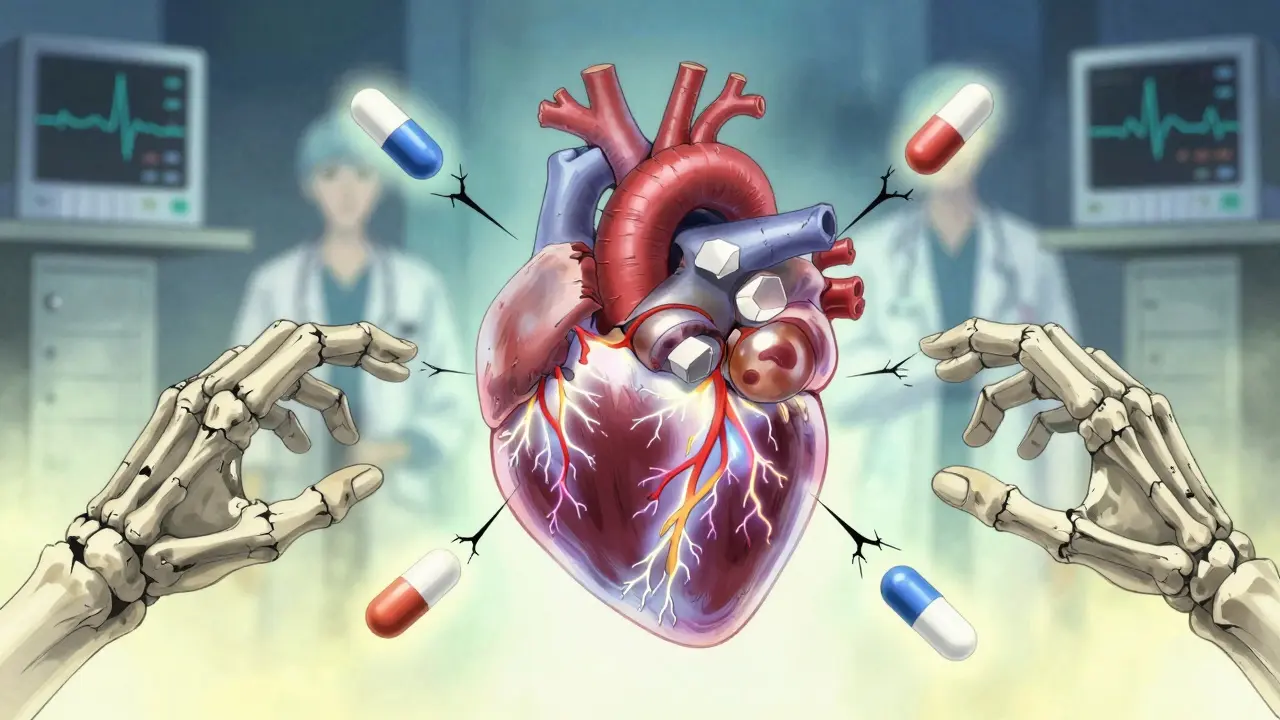
A drug-induced arrhythmia happens when a medication messes with the electrical signals that keep your heart beating steadily. Instead of a steady thump-thump, your heart might flutter, race, skip, or pause. Some of these rhythms are annoying. Others can kill you in minutes.
The most dangerous type is QT prolongation. This is when the heart’s electrical recovery phase gets stretched out. It doesn’t sound serious - until it triggers torsades de pointes, a wild, twisting ventricular rhythm that can collapse into cardiac arrest. This isn’t theoretical. It’s happened to people taking common drugs like azithromycin, ciprofloxacin, and even some antihistamines.
It’s not just one drug. It’s combinations. Taking two QT-prolonging meds together can increase your risk by 300 to 500%. That’s not a typo. It’s why doctors need to check your full list of medications - not just the one they prescribed.
Which Medications Are the Biggest Culprits?
You’d be surprised how many everyday prescriptions carry this hidden risk. Here are the main offenders:
- Antibiotics: Macrolides like azithromycin and fluoroquinolones like levofloxacin. These are among the top causes of drug-induced arrhythmias, especially in the first week of use.
- Antidepressants and antipsychotics: Drugs like citalopram, escitalopram, and haloperidol can block potassium channels in the heart. Even low doses can be risky in older adults.
- Antiarrhythmics themselves: Flecainide and propafenone are meant to fix rhythm problems - but they can make them worse. About 5-10% of people on these drugs develop new or worse arrhythmias.
- Digoxin: Used for heart failure and atrial fibrillation. Toxicity happens easily if your kidneys aren’t working well or if you’re low on magnesium. Symptoms include nausea, confusion, and sudden fast heartbeats with blocked signals.
- Diuretics: Water pills like furosemide can drain potassium and magnesium - two minerals your heart needs to stay steady. Low levels are a major trigger.
- Cancer drugs: Trastuzumab (Herceptin) can cause atrial fibrillation through inflammation and oxidative stress. It’s not common, but it’s serious.
And don’t forget: even over-the-counter meds like pseudoephedrine (in cold pills) or herbal supplements like licorice root can push your heart out of rhythm.
Warning Signs You Can’t Ignore
Most people don’t feel a heart rhythm problem until it’s already serious. But there are clues - if you know what to look for.
- Palpitations: That fluttering, pounding, or skipping feeling in your chest. Happens in 70-80% of cases.
- Dizziness or lightheadedness: Especially if it comes with standing up or after taking a new pill.
- Fatigue that doesn’t go away: Not just tired from a long day - total exhaustion that feels different from normal.
- Chest discomfort: Not always sharp pain. Sometimes just pressure, fullness, or a weird tightness.
- Fainting or near-fainting: This is a red flag. If you’ve passed out - even for a second - after starting a new medication, get checked immediately.
These symptoms don’t always mean arrhythmia. But when they show up after starting a new drug - especially if you’re over 65, have kidney issues, or take multiple meds - they’re a signal to act.
Who’s Most at Risk?
Not everyone is equally vulnerable. Three big risk factors stand out:
- Age 65+: Over 60% of severe cases involve older adults. Kidneys slow down. Electrolytes drop. Drug clearance gets slower. Your body can’t handle the same doses it used to.
- Low potassium or magnesium: About 20% of patients with drug-induced arrhythmias have low potassium. Nearly 15% are low in magnesium. These aren’t just numbers - they’re critical for heart function.
- Heavy alcohol use: More than three drinks a day triples your risk. Alcohol directly affects heart cell electrical activity and worsens electrolyte loss.
There’s also a genetic layer. Around 15% of people of African ancestry carry the S1103Y gene variant. About 12% of East Asian people carry R1193Q. These variants make heart cells way more sensitive to QT-prolonging drugs. Right now, most doctors don’t test for them - but that’s changing.
How Doctors Diagnose and Monitor
It starts with an ECG. Before starting high-risk meds - like certain antibiotics, antidepressants, or antiarrhythmics - your doctor should take a baseline ECG. Then, repeat it within 72 hours. Why? Because the biggest changes happen fast.
If your QT interval is longer than 450 milliseconds in men or 460 in women, that’s a warning. If it goes above 500, the risk of torsades jumps sharply. Your doctor should also check your potassium and magnesium levels regularly - especially if you’re on diuretics.
For people on digoxin, blood levels matter. Anything above 2 ng/mL is toxic. In older adults with kidney problems, that level can creep up even on normal doses.
Some hospitals now use automated alerts in their electronic systems. If you’re prescribed a QT-prolonging drug and you’re on another one, the system flags it. But not all clinics have that. So you need to be your own advocate.
What to Do If You Suspect a Problem
If you feel new heart symptoms after starting a medication:
- Don’t stop the drug cold. Some meds, like beta-blockers or antiarrhythmics, can cause rebound effects if you quit suddenly.
- Call your doctor. Tell them exactly what you’re feeling and when it started. Mention every pill you’re taking - including supplements and OTC drugs.
- Get an ECG. Don’t wait. Even if you feel better, the rhythm problem might still be there.
- Check your electrolytes. A simple blood test can reveal if potassium or magnesium is low.
In most cases - 75 to 85% - the arrhythmia clears up once the drug is stopped or the dose is lowered. For some, like beta-blocker-induced bradycardia, reducing the dose fixes it in 60-70% of cases. But if the rhythm doesn’t settle, or if you’ve had fainting episodes, you might need a pacemaker. Catheter ablation helps in 5-10% of stubborn cases. Surgery? Less than 2%.

How to Protect Yourself
Prevention beats treatment every time. Here’s what works:
- Keep a full med list. Include vitamins, supplements, and OTC drugs. Bring it to every appointment.
- Ask: “Can this cause heart rhythm problems?” Especially if you’re over 60 or have kidney disease.
- Limit alcohol. Stick to one drink a day - or none if you’re on high-risk meds.
- Watch your salt and sugar. High sodium worsens fluid shifts. High sugar increases inflammation. Both strain the heart.
- Stay hydrated. Especially if you’re on diuretics. Dehydration drops potassium fast.
- Don’t self-medicate. Don’t take extra cold pills or pain relievers without checking with your pharmacist.
And yes - caffeine can trigger palpitations. About 25-30% of people report it. But serious arrhythmias from caffeine alone? Extremely rare. Still, if you’re already at risk, skip the energy drinks and double espressos.
The Future: Personalized Medicine Is Here
Science is catching up. Researchers at Vanderbilt used CRISPR-edited heart cells to prove that people with the S1103Y or R1193Q gene variants are far more likely to have dangerous reactions. That’s not science fiction - it’s a path forward.
The FDA has added black box warnings to 25 drugs since 2010. Eight were added in 2022 alone. That means regulators are paying attention.
By 2024, the American College of Cardiology will roll out a digital tool that calculates your personal risk: age, meds, electrolytes, kidney function, and genetic markers. It won’t be perfect - but it’ll be a huge step.
Experts predict a 30-40% drop in severe drug-induced arrhythmias over the next five years - if we start using genetic screening and smarter prescribing.
Bottom Line
Medications save lives. But they can also stop them - quietly, without warning. The key isn’t avoiding pills. It’s knowing which ones carry hidden risks and how to spot the early signs. If you’re on any long-term medication, especially if you’re older or take more than three, talk to your doctor. Ask about your heart rhythm. Get an ECG if you’re unsure. Your life might depend on it.

Nicola George
December 27, 2025 AT 19:53So let me get this straight - we’re giving people antibiotics like candy and then acting shocked when their hearts go rogue? Classic. I’ve seen this in the ER three times last month. No one asks about meds. No one checks electrolytes. We just patch and release. And then the family shows up asking why Grandma didn’t make it to Thanksgiving.
Robyn Hays
December 29, 2025 AT 15:57I’m a nurse and I can’t tell you how many times patients say, ‘But my cousin took this same pill and she’s fine!’ - as if biology is a lottery you can cheat. The truth? Your genes, your kidneys, your magnesium levels - they’re all part of the equation. And no, your cousin’s body isn’t your body. Stop self-diagnosing with WebMD and talk to your doctor before you pop another pill.
Caitlin Foster
December 30, 2025 AT 23:29THIS. THIS. THIS. 🙌 I’ve been screaming about this for YEARS! People think ‘natural’ means safe - hello, licorice root is a heart rhythm terrorist! And don’t even get me started on energy drinks + Z-Pak. That’s not a lifestyle choice - it’s a cardiac dare. Someone please make a meme about this before someone dies on a TikTok challenge.
Will Neitzer
December 31, 2025 AT 07:48The clinical implications of polypharmacy-induced QT prolongation cannot be overstated. A retrospective cohort analysis published in the Journal of the American College of Cardiology in 2023 demonstrated a 4.7-fold increase in torsades de pointes incidence among patients prescribed ≥2 QT-prolonging agents concomitantly, even in the absence of structural heart disease. The imperative for pre-prescription ECG screening and electrolyte monitoring is not merely prudent - it is ethically non-negotiable.
James Bowers
January 1, 2026 AT 00:49It’s astonishing how many physicians still treat patients as if they’re lab rats with identical physiology. You prescribe azithromycin to an elderly woman on furosemide and digoxin, and you’re not surprised when she collapses? That’s not negligence - it’s arrogance. We have the tools. We have the data. We just refuse to use them.
Kylie Robson
January 1, 2026 AT 03:10Let’s be clear: S1103Y and R1193Q variants are not ‘ethnic quirks’ - they’re pharmacogenomic red flags. The FDA’s black box warnings are reactive, not proactive. We need mandatory genotyping for patients over 60 on polypharmacy regimens. The cost of one ICU admission outweighs the cost of a $120 SNP panel. Why are we still flying blind?
Janice Holmes
January 1, 2026 AT 22:27MY HEART IS STILL RACING JUST READING THIS. 😱 Like… I was on citalopram for 8 months and never knew it was basically playing Jenga with my ventricles. And then I took a cold med with pseudoephedrine - and suddenly I was feeling like my chest was a drum solo. I thought I was having a panic attack. Turns out? I was one ECG away from code blue. This isn’t fearmongering. It’s survival.
Andrew Gurung
January 2, 2026 AT 19:23Of course you’re all shocked. But let’s be honest - the medical system is a glorified pharmaceutical vending machine. They don’t care if your heart skips a beat - as long as you refill your prescriptions. And don’t even get me started on the ‘just take a magnesium supplement’ advice. You think a $5 gummy is going to fix a drug-induced ion channel catastrophe? 😒
Anna Weitz
January 3, 2026 AT 02:21We’re all just meat machines with electrical wiring and someone forgot to label the wires. You take a pill you don’t understand for a symptom you don’t feel and suddenly your heart decides to audition for a heavy metal band. The real question isn’t which drugs are dangerous - it’s why we let corporations decide what gets put in our bodies without consent
Paula Alencar
January 3, 2026 AT 04:50As a geriatric cardiology nurse practitioner, I can attest that the majority of drug-induced arrhythmias in patients over 75 are preventable - yet they persist due to fragmented care, lack of medication reconciliation, and the false assumption that ‘if it’s prescribed, it’s safe.’ The ECG is not an optional luxury; it is the most underutilized diagnostic tool in outpatient medicine. Every patient on ≥3 medications should have a baseline and a repeat ECG at 72 hours. Period.
Monika Naumann
January 3, 2026 AT 21:05In my country, we do not rely on expensive genetic tests or fancy algorithms. We rely on tradition, experience, and respect for the physician. If your doctor prescribes, you take. If you feel strange, you come back. We do not blame the medicine - we blame the patient for being weak. This Western obsession with testing and fear is making people sick with anxiety, not arrhythmias.
Elizabeth Ganak
January 4, 2026 AT 14:39honestly though i just take my meds and try not to think about it lol. i’m 72 and on 7 pills. if my heart skips i just drink water and chill. it always goes back to normal. maybe i’m lucky? or maybe y’all are overthinking this? 🤷♀️
Alex Lopez
January 5, 2026 AT 02:02So let me get this straight - we’ve got a $200 billion pharmaceutical industry, AI-powered ECG alerts, and CRISPR-edited heart cells… but we still can’t get a single doctor to ask, ‘What else are you taking?’ 😂 I mean, I’m impressed by the science. I’m horrified by the system.
Nikki Thames
January 6, 2026 AT 05:09It’s not just about the drugs. It’s about the silence. The silence between the pharmacist and the doctor. The silence between the patient and the nurse. The silence between the warning label and the person who can’t read it. We’ve built a healthcare system that speaks in jargon, and expects patients to understand it without translation. That’s not negligence - it’s violence.