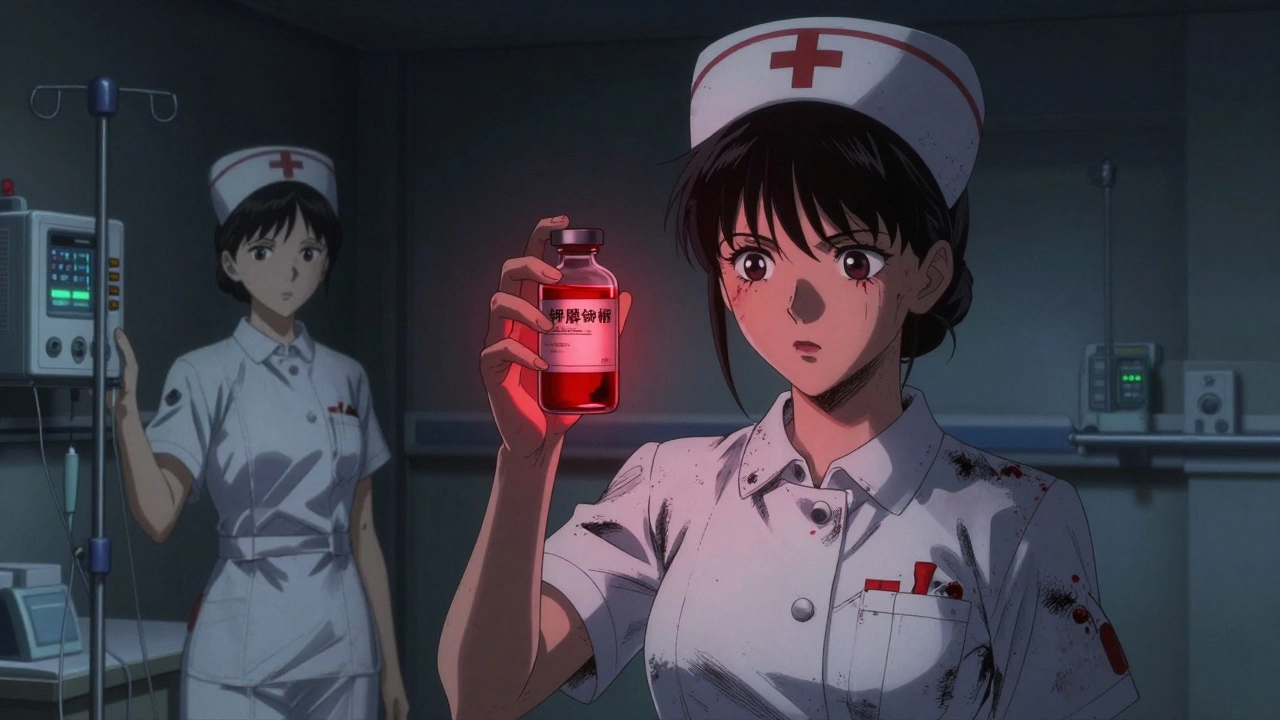
When a nurse walks into a patient’s room with a vial of concentrated potassium chloride or an IV pump set to deliver insulin, the stakes are never higher. One wrong digit, one misread decimal, one rushed check - and a patient can die. That’s why high-alert medications aren’t just another item on the med cart. They’re the ones that demand a second pair of eyes, a quiet moment, and a real, independent verification - not just a quick nod and a signature.
What Makes a Medication High-Alert?
Not all dangerous drugs are obvious. Some look harmless. A clear liquid in a small vial. A syringe filled with something labeled "KCl." But this isn’t just salt water. This is concentrated potassium chloride - 1 mEq/mL or higher. Give it too fast, give it by mistake, and it can stop a heart in minutes. That’s why the Institute for Safe Medication Practices (ISMP) first defined high-alert medications in 2001. Their 2024 list, updated just months ago, still stands as the industry standard. These aren’t drugs that cause side effects. They’re drugs that cause catastrophic harm when something goes wrong - even if the error is rare. Think insulin infusions. Neuromuscular blockers. Heparin. Chemotherapy. These aren’t "maybe" risks. They’re "definitely" life-or-death risks. The ISMP doesn’t say these drugs are used more often. They say the consequences of an error are so severe, you can’t afford to rely on memory, labels, or speed.Which Medications Require a Double Check?
There’s no single universal list, but most hospitals follow the ISMP’s 2024 guidelines. Here’s what’s consistently flagged:- Insulin - especially IV infusions and bolus doses
- Potassium chloride concentrate (1 mEq/mL or higher)
- Potassium phosphate concentrate (1 mEq/mL or higher)
- Neuromuscular blocking agents (like rocuronium or succinylcholine)
- Intravenous heparin - including flushes over 100 units/mL
- Direct thrombin inhibitors (argatroban, bivalirudin)
- Injectable narcotic patient-controlled analgesia (PCA) pumps
- Chemotherapy agents - all forms
- Total parenteral nutrition (TPN) and lipids
- Continuous renal replacement therapy (CRRT) solutions like Prismasol
- High-concentration sodium chloride (>0.9%)
- All controlled substances (especially IV opioids)
The Real Meaning of "Independent Double Check"
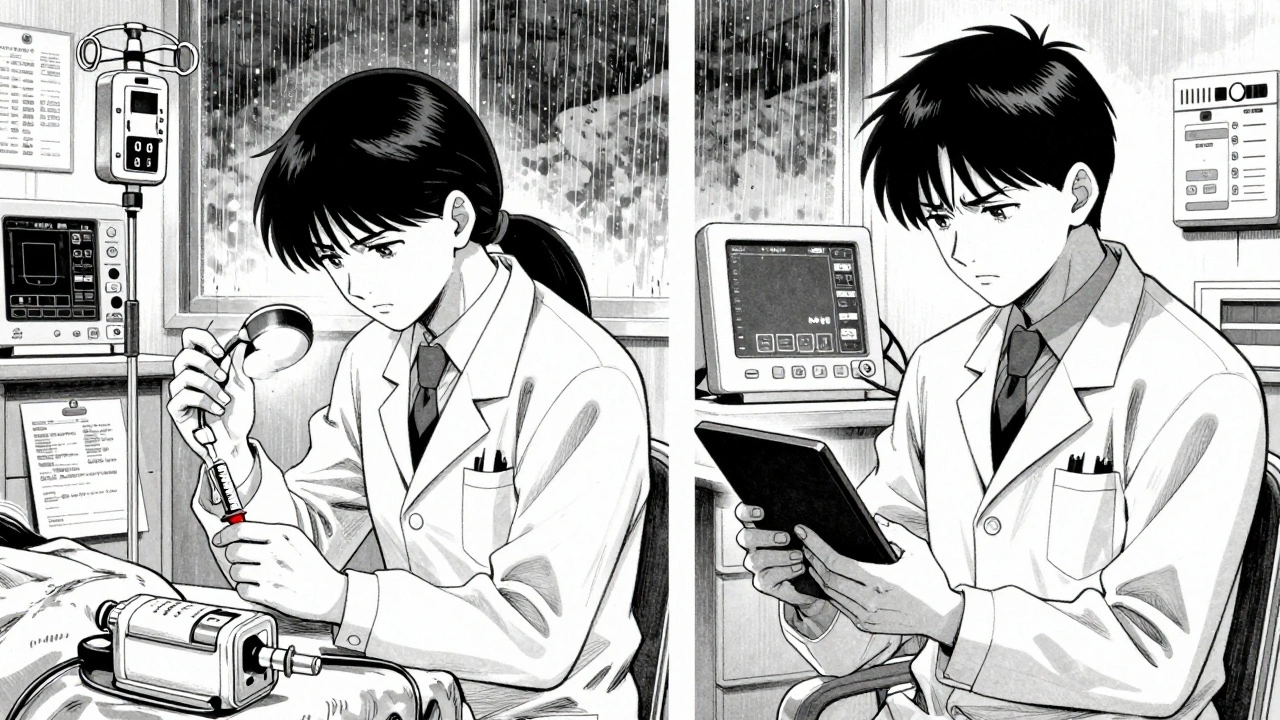
A double check isn’t two people standing side by side, glancing at the same label. That’s not a check - that’s a group think. The real safety comes from independence. According to VHA Directive 1195 (updated October 2024), an independent double check means two licensed clinicians - alone, apart, and without talking - each verify the same five critical elements:- Right patient - two identifiers (name, date of birth, medical record number)
- Right medication - matching the drug name on the label to the order
- Right dose - checking strength, volume, concentration
- Right route - IV, IM, oral? Not confused with another route
- Right time - is this dose due now? Is it scheduled correctly?
Why So Many Hospitals Get It Wrong
You’d think if the data is this clear, everyone would do it right. But reality is messier. In one ICU nurse’s Reddit post from 2023, they said: "I’ve caught three critical errors in six months through proper double checks. But I’ve seen 12 rushed ones where both nurses just signed off without even looking at the pump settings." That’s not safety. That’s ritual. Common failures:- Checking during emergencies - no time, no second nurse available
- Skipping the calculation - assuming the pharmacy got it right
- Using the same person twice - the charge nurse checks their own work
- Not verifying pump settings - the machine says 5 mL/hr, but the order was 0.5 mL/hr
- Documentation as an afterthought - signing the eMAR without confirming the check actually happened
What Works: Real-World Success Stories
Johns Hopkins Hospital saw IV heparin dosing errors drop from 12.7% to 2.3% over 18 months - not by adding more staff, but by fixing how they did double checks. They trained nurses on true independence. They built time into the shift. They made sure the second checker didn’t know what the first one expected to see. Mayo Clinic doesn’t treat double checks as a burden. They count the time into staffing. If a nurse needs three minutes for a double check, they schedule for it. No guilt. No rushing. Cleveland Clinic requires a two-hour competency module before anyone can perform double checks. Nurses must pass a test on real-world scenarios. Pass rate? 95%. That’s not luck. That’s discipline. And it’s not just people. Hospitals that use smart pumps - devices that flag dose errors before they’re given - combined with targeted double checks, cut errors by 63%. That’s better than either method alone.
The Bigger Picture: Safety Isn’t About Checks - It’s About Systems
The ISMP doesn’t believe every high-alert medication needs a manual double check. In fact, they warn against overuse. Why? Because if you do it for everything, people stop paying attention. It becomes noise. The smarter approach? Use double checks only for the highest-risk tasks - IV insulin, chemotherapy, heparin, paralytics - and layer in other safeguards:- Smart pumps with dose error reduction systems (DERS)
- Barcoding systems that match the patient, drug, and dose
- Pre-filled syringes from the pharmacy
- Automated alerts in the electronic medical record
What You Can Do Right Now
If you’re a nurse, pharmacist, or clinician:- Know your institution’s list of high-alert medications. If you don’t, ask for it.
- Ask: "Is this a true independent check?" If the second person is watching the first, it’s not.
- Never skip the calculation - even if the label says "10 units." Recalculate it yourself.
- Check the pump settings - not just the screen, but the actual programmed rate and volume.
- Document properly. If it’s not signed in the eMAR, it didn’t happen.
- Don’t assume staff know how to do a proper double check. Train them.
- Build time into schedules. Don’t punish nurses for taking three extra minutes to save a life.
- Use technology - smart pumps, barcoding, eMAR dual signatures.
- Audit your double checks. Are they real? Or just paperwork?
Final Thought: Safety Isn’t Optional
You can’t afford to treat high-alert medications like everything else. The margin for error is zero. A double check isn’t bureaucracy. It’s the last line of defense. And if you’re doing it wrong - if it’s rushed, if it’s not independent, if it’s just a checkbox - you’re not protecting patients. You’re just pretending to. The science is clear. The data is clear. The lives depend on it.What medications require an independent double check?
Medications that require an independent double check include IV insulin, concentrated potassium chloride (1 mEq/mL or higher), neuromuscular blocking agents, IV heparin (including flushes over 100 units/mL), chemotherapy agents, direct thrombin inhibitors, narcotic PCA pumps, total parenteral nutrition (TPN), and CRRT solutions. Most hospitals follow the 2024 ISMP High-Alert Medications List, but institutional policies may vary. Always refer to your facility’s official protocol.
What is an independent double check?
An independent double check is when two licensed healthcare professionals verify a medication separately, without speaking to each other, before administration. Each person independently confirms the right patient, right medication, right dose, right route, and right time. Only after both have completed their checks do they compare results. This prevents bias and ensures errors are caught.
Are double checks always necessary?
No. The Institute for Safe Medication Practices (ISMP) advises against using manual double checks for every high-alert medication. Overuse leads to complacency. Double checks should be reserved for the highest-risk medications - like IV insulin, chemotherapy, or neuromuscular blockers - and combined with other safety tools like smart pumps and barcoding. The goal is smart redundancy, not blanket procedures.
What happens if the two people disagree during a double check?
The medication administration is stopped immediately. The discrepancy is documented, and a pharmacist or senior clinician is consulted to resolve the issue. Never proceed if there’s any doubt. The purpose of the double check is to catch errors - not to confirm assumptions. A disagreement means a potential error was found - and that’s the point.
Can a pharmacist and nurse do the double check together?
Yes - but only if they perform the check independently. One person verifies the order, dose, and pump settings alone. The other does the same, separately. Then they compare results. If they stand side by side, talk through the process, or rely on each other’s verbal confirmation, it’s not an independent double check. The independence is what makes it effective.
Do electronic signatures count as proof of a double check?
Only if the system is designed to enforce true independence. Many electronic medication administration records (eMARs) now require two separate logins, timestamps, and digital signatures - with no option to proceed unless both are completed. If the system allows one person to sign for both, or if the second signature is just a formality, then it’s not reliable. The technology must support, not replace, the process.
How often should staff be trained on double checks?
Initial training should include a minimum of two hours of hands-on practice with real scenarios and competency testing. Annual refreshers are essential. Some hospitals, like Cleveland Clinic, require a passing score of 95% on annual assessments. Training should include video examples, mock errors, and audits of real cases to reinforce why independence matters.
Lydia Zhang
December 2, 2025 AT 22:29Been doing this for 12 years. Half the time the second nurse is scrolling on their phone while signing.
Tommy Walton
December 3, 2025 AT 15:53Human error is a feature, not a bug. We're not machines. Let the algorithm handle the math. Let the nurse handle the soul.
James Steele
December 5, 2025 AT 00:25The institutionalization of redundancy as a proxy for competence is a postmodern tragedy. We've outsourced vigilance to checklists while our cognitive architecture atrophies. The double-check isn't a safeguard-it's a symptom of systemic epistemic collapse.
Smart pumps? Barcoding? These are palliatives. The real pathology is the erosion of clinical intuition. We train nurses to validate, not to think.
And yet, paradoxically, the very act of independent verification preserves the last vestige of professional autonomy. How ironic.
Louise Girvan
December 5, 2025 AT 05:32They're lying. They're always lying. The 'independent' check? The second nurse is the boss's cousin. The eMAR logs are faked. The pharmacy's 'pre-filled' syringes? They're repackaged from expired stock. You think they care about patients? They care about liability waivers.
soorya Raju
December 5, 2025 AT 19:54USA always overcomplicate. In India we just ask patient name, check label, push button. No double check. No smart pump. But we never make mistake. Because we trust. You trust machine? You trust paper? We trust God.
Grant Hurley
December 6, 2025 AT 20:57Just had a guy in med-surg almost get 10x the insulin dose because the pump was set wrong. Second nurse didn’t even look at the screen-just tapped the eMAR. We need to stop treating this like a paperwork dance.
Also, shoutout to the ICU nurse who caught three errors. You’re the real MVP.
Shannon Gabrielle
December 8, 2025 AT 02:00Of course the VHA does it right. They're the only ones who don't outsource everything to contractors and then blame nurses when the system crashes. You want safety? Stop privatizing healthcare and start paying people to do their damn jobs.
Jeremy Butler
December 10, 2025 AT 00:05It is my considered opinion, grounded in both empirical observation and ethical praxis, that the proceduralization of clinical judgment-however well-intentioned-constitutes a form of epistemic delegation that, over time, diminishes the ontological authority of the practitioner. The double-check, as currently implemented, functions not as a safeguard, but as a performative ritual designed to absolve institutional accountability.
Courtney Co
December 10, 2025 AT 11:38Wait, so if I’m the second nurse and I don’t know what the first nurse saw… how do I even know what to look for? Like… do I just guess? What if I’m new? What if I’m tired? What if I just had a panic attack in the bathroom? You can’t just say ‘be independent’ and expect people to magically be perfect.
I’ve been crying at my desk for an hour after a near-miss. Nobody asked if I was okay. They just said ‘sign here.’
Shashank Vira
December 10, 2025 AT 19:10Ah, the sacred ritual of the double-check. A ballet of bureaucracy performed under fluorescent lights while the soul of medicine dies quietly in the corner. The ISMP knows this. The VHA knows this. But they will not admit the truth: we are not saving lives-we are performing the illusion of safety for auditors, lawyers, and the anxious ghosts of patients we failed last week.
Smart pumps? Barcoding? These are not solutions. They are digital bandaids on a corpse. The real cure? Respect. Autonomy. Time. And the courage to say: ‘I don’t know.’
But no. We’ll keep signing. We’ll keep checking. We’ll keep pretending.