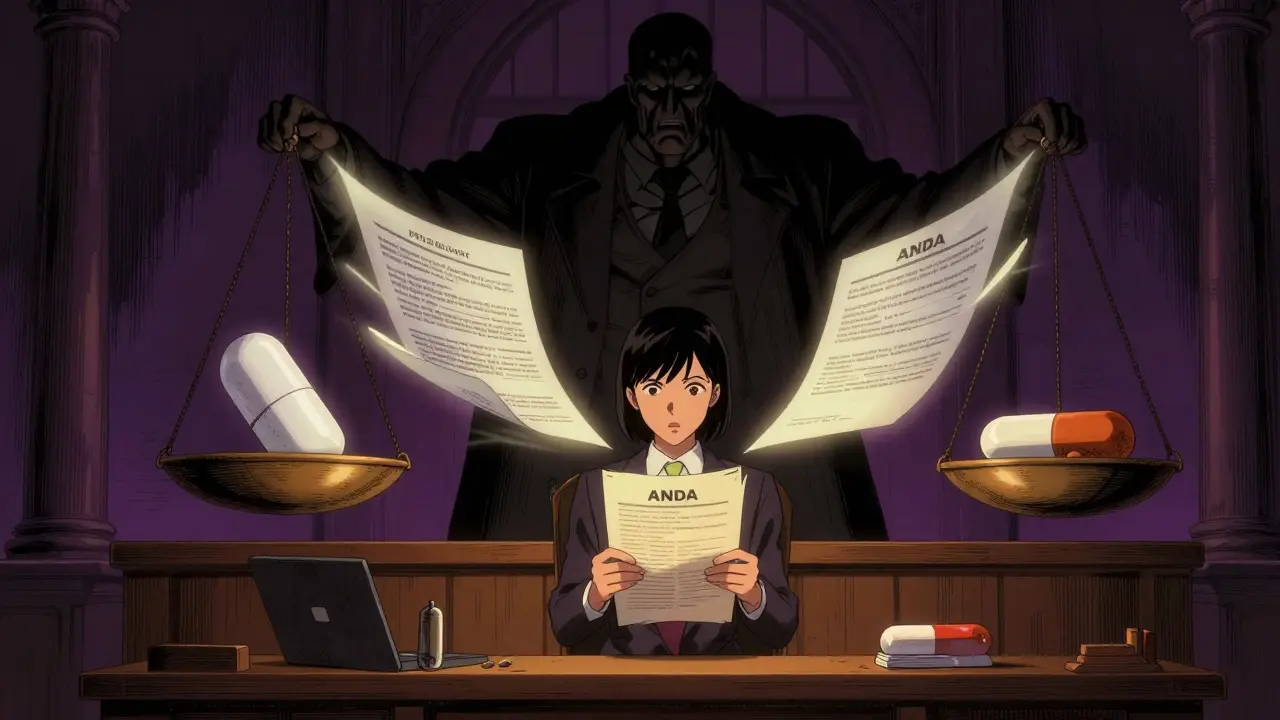
The ANDA process is the backbone of generic drug approval in the United States. It’s how companies get FDA clearance to sell cheaper versions of brand-name medications-without repeating expensive clinical trials. This system didn’t just appear out of nowhere. It was created by law, specifically the Drug Price Competition and Patent Term Restoration Act of 1984, better known as the Hatch-Waxman Act. Signed by President Reagan, this law was designed to strike a balance: protect innovator drug companies’ patents while letting generics enter the market faster. The result? Today, 90% of prescriptions filled in the U.S. are for generic drugs, but they cost only about 23% of what brand-name drugs do. That’s over $2.2 trillion saved in the last decade alone.
What Exactly Is an ANDA?
An Abbreviated New Drug Application (ANDA) is a regulatory submission to the FDA that proves a generic drug is the same as its brand-name counterpart. The word “abbreviated” is key here. Unlike the full New Drug Application (NDA) that brand companies must file-which includes years of clinical trials on safety and effectiveness-an ANDA skips all that. Instead, it relies on the FDA’s prior approval of the original drug, called the Reference Listed Drug (RLD). All the generic maker has to prove is that their version is therapeutically equivalent.
That doesn’t mean the bar is low. The FDA demands strict proof in four main areas: active ingredients, dosage form, strength, and route of administration. If your generic doesn’t match the RLD exactly in these areas, you can’t file an ANDA. There are exceptions-like if you want to change the inactive ingredients-but those require a special petition under Section 505(j)(2)(C) of the Federal Food, Drug, and Cosmetic Act. Most companies avoid those complications and stick to exact copies.
The Core Legal Requirements
To get an ANDA approved, you must meet these non-negotiable requirements:
- Identical active ingredient: The same chemical compound, in the same amount, with no variation. Even small changes can trigger rejection.
- Same dosage form and strength: If the brand is a 10mg tablet taken orally, your generic must be too. No capsules, no liquids, no higher doses unless you go through a separate approval path.
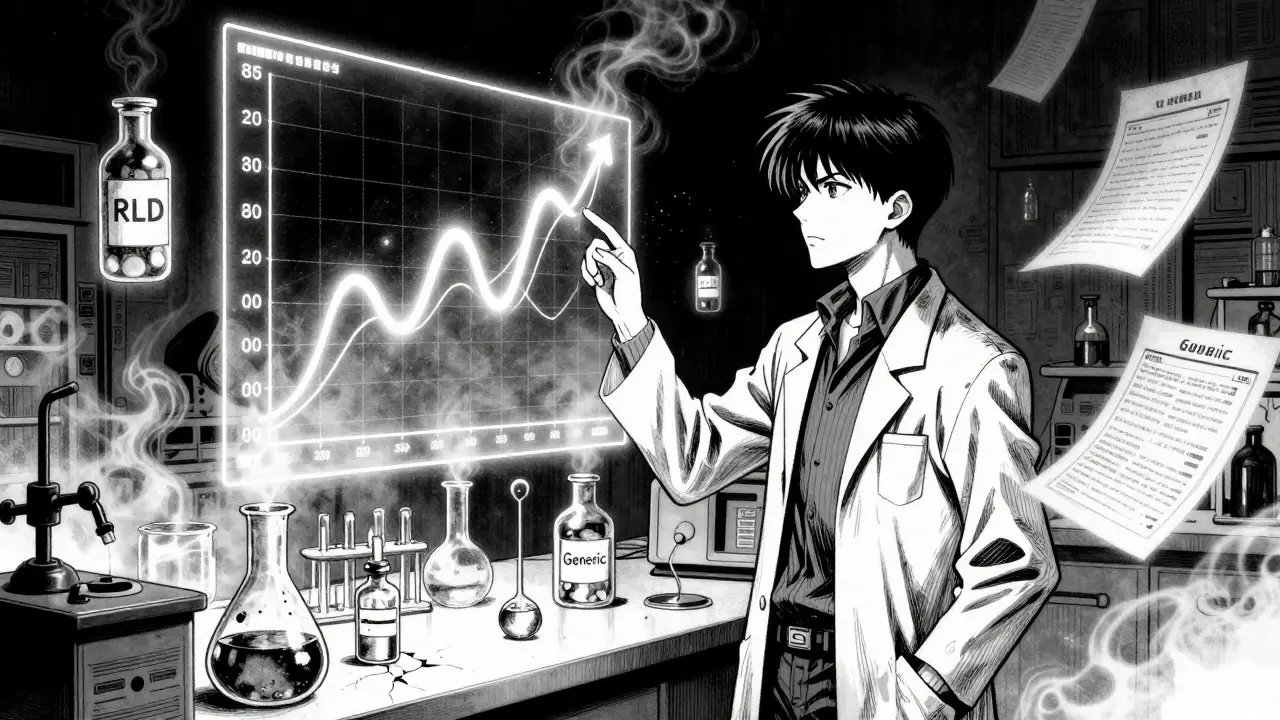
- Bioequivalence: This is where science meets regulation. You must show your drug behaves the same way in the body as the RLD. The FDA requires pharmacokinetic studies proving your drug’s absorption rate (Cmax) and total exposure (AUC) fall within 80-125% of the brand. This range isn’t arbitrary-it’s based on decades of clinical data showing no meaningful difference in therapeutic effect within these bounds.
- Identical labeling: Your package insert must match the brand’s, except for minor changes like omitting the brand name or adding a generic manufacturer’s logo. You can’t claim extra benefits or safety advantages.
- Manufacturing quality: Every step of production-from raw materials to final packaging-must follow Current Good Manufacturing Practices (cGMP). The FDA inspects your facility, often without warning. If they find a single major violation, your application gets rejected.
Submission must be in the Electronic Common Technical Document (eCTD) format. Paper submissions are no longer accepted. You also need to file Form FDA-356h (the application form) and Form FDA-3674 (the user fee cover sheet). Missing either? Your application gets refused to receive-no review, no chance.
Costs and Fees
Compared to developing a new drug-which can cost over $2 billion-an ANDA is cheap. The average development cost is between $5 million and $10 million. But that doesn’t mean it’s easy. The FDA charges a Generic Drug User Fee Amendment (GDUFA) fee of $129,500 for an original ANDA submission in fiscal year 2024. There’s also a $5,000 fee for any supplement you file later, like changing your manufacturing site or adding a new strength.
These fees fund the FDA’s review process. Without them, review times would balloon. GDUFA III (2023-2027) set new performance goals: 90% of standard ANDAs reviewed within 10 months, and priority ones in 8 months. That’s a big drop from the 30-month average in 2015. But meeting those targets requires clean, complete applications. The FDA’s 2022 data shows 58% of first-time submissions get deficiency letters-meaning they’re rejected for missing or unclear information.
Patent and Exclusivity Hurdles
One of the trickiest parts of the ANDA process isn’t science-it’s law. The Hatch-Waxman Act lets generic companies file their application up to four years before a brand-name drug’s patent expires. But when they do, they must make a legal statement, called a paragraph certification, about how they’re handling patents. There are four types:
- Paragraph I: The patent hasn’t been listed in the FDA’s Orange Book.
- Paragraph II: The patent has expired.
- Paragraph III: The patent will expire on a certain date-your product will launch then.
- Paragraph IV: The patent is invalid or won’t be infringed. This is the most controversial one.
If you file a Paragraph IV certification, the brand-name company has 45 days to sue you for patent infringement. If they do, the FDA can’t approve your drug for 30 months-or until a court rules otherwise. That’s called a 30-month stay. Many companies use this delay tactic to protect their market. In fact, between 2015 and 2020, brand manufacturers filed over 1,450 patents on already-approved drugs to block generics. The FDA calls this “evergreening,” and it’s a major reason why some generic approvals take 4-5 years instead of 10 months.
Complex Generics: The New Challenge
Not all drugs are created equal. Simple pills? Easy to copy. Inhalers, nasal sprays, injectables, topical creams? Not so much. These are called complex generics. Their delivery systems matter just as much as the drug itself. A generic inhaler must deliver the exact same particle size, spray pattern, and dose consistency as the brand. That’s hard to prove.
The FDA’s approval rate for complex generics is only 42% on first review-compared to 78% for simple pills. Companies like Teva spent over $28 million and 42 months getting approval for a generic version of Advair Diskus. Their application was rejected three times over device testing issues. Meanwhile, Lupin got approval for a generic version of Jardiance in just 9.5 months because they submitted a “clean” application with flawless Chemistry, Manufacturing, and Controls (CMC) data.
The FDA’s 2023 Drug Competition Action Plan is now investing $15 million into scientific tools to help reviewers evaluate these complex products. But until those tools are fully in place, companies are stuck guessing what the FDA wants. One regulatory affairs specialist on Reddit said: “We’ve had three ANDAs rejected because we didn’t validate the container closure system well enough.” That’s the kind of detail that can cost you years and millions.
How to Succeed in the ANDA Process
If you’re trying to navigate this system, here’s what actually works:
- Start with the Orange Book: Identify the exact RLD. There are over 20,800 approved products listed there. Pick the right one.
- Do your patent homework: Map every patent and exclusivity period. Don’t assume-verify with the FDA’s database.
- Use pre-ANDA meetings: In 2022, the FDA held over 1,800 of these. They’re free. Use them. Ask questions. Get feedback before you spend $10 million.
- Invest in CMC documentation: This is where most applications fail. Don’t cut corners on stability studies, manufacturing controls, or packaging validation.
- Train your team: Regulatory affairs professionals with RAC certification earn $125,000 on average. They’re worth it. The FDA offers training sessions for $450 each. Take them.
There’s no magic trick. Success comes from precision, patience, and paying attention to the tiny details most companies overlook.
Where the System Stands Today
The U.S. generic drug market hit $127.3 billion in 2022. That’s 84% of the total prescription drug market. Teva leads with 18.7% market share, followed by Sandoz and Amneal. But the real story isn’t market size-it’s access. Generics make life-saving drugs affordable. A diabetes pill that costs $300 as a brand is $12 as a generic. A hypertension medication that used to be $200 a month? Now it’s $5.
Still, challenges remain. The FDA is seeing more complex products, more patent delays, and more overseas manufacturing issues. In 2022, 68% of FDA Form 483 observations (warning letters) went to foreign facilities. That’s why the agency is pushing for better global oversight and more real-time communication with applicants.
The future? GDUFA III is helping. Review times are shrinking. AI-assisted document review is coming. But the core of the system remains unchanged: if you can prove your drug is identical to the brand, the FDA will approve it. The law is clear. The science is solid. The only thing standing between a generic drug and the market is the quality of the application.
What is the main purpose of the ANDA process?
The main purpose of the ANDA process is to allow generic drug manufacturers to gain FDA approval for drugs that are identical to brand-name medications without repeating costly clinical trials. It promotes competition, lowers drug prices, and increases patient access to affordable medications while ensuring safety and effectiveness through strict bioequivalence and manufacturing standards.
How long does it take to get an ANDA approved?
Under GDUFA III (2023-2027), the FDA aims to approve 90% of standard ANDAs within 10 months and priority generics within 8 months. However, complex generics or those involving patent litigation can take 30 months or longer. The average approval time was 36 months in 2022, down from 30 months in 2015, due to rising deficiency rates and patent delays.
What happens if a generic drug doesn’t meet bioequivalence standards?
If a generic drug fails to demonstrate bioequivalence-meaning its absorption rate or total exposure falls outside the 80-125% range of the brand-name drug-the FDA will not approve it. The application is rejected, and the company must revise its study, resubmit, and restart the review process. Bioequivalence is non-negotiable; it’s the scientific foundation of the entire ANDA pathway.
Can a generic drug have different inactive ingredients than the brand?
Yes, but only under specific conditions. The active ingredient must be identical, but inactive ingredients (like fillers, dyes, or preservatives) can differ. However, if the change affects how the drug is absorbed or used, the manufacturer must submit a suitability petition under Section 505(j)(2)(C) of the FD&C Act. Most companies avoid this route because it adds time, cost, and regulatory risk.
Why are complex generics harder to approve than simple pills?
Complex generics-like inhalers, nasal sprays, or topical creams-depend on how the drug is delivered, not just what’s in it. A generic inhaler must match the brand’s spray pattern, particle size, and dose consistency. Proving this requires advanced testing methods that the FDA is still developing. As a result, only 42% of complex generic applications are approved on first review, compared to 78% for simple oral tablets.
What is the role of the Hatch-Waxman Act in the ANDA process?
The Hatch-Waxman Act created the legal framework for the ANDA process. It established the pathway for generic approval while protecting brand-name drug patents. It introduced patent certification (Paragraph I-IV), 30-month stays for patent litigation, and 5 years of data exclusivity for new drugs. Without this law, generic drugs would not be able to enter the market efficiently, and drug prices would remain much higher.
How does the FDA ensure generic drugs are safe?
The FDA ensures safety by requiring identical active ingredients, bioequivalence proof, and strict adherence to cGMP standards. Every manufacturing facility is inspected, and stability data must show the drug remains effective and safe over its shelf life. The FDA also monitors post-market reports and can withdraw approval if safety issues arise. The same standards apply to generics as to brand-name drugs.
What is the difference between ANDA and 505(b)(2) applications?
An ANDA requires exact equivalence to a brand-name drug and relies entirely on the FDA’s prior findings. A 505(b)(2) application allows changes-like a new dosage form, route of administration, or combination-and can rely on some existing data, but still requires new clinical studies. ANDAs cost $5-10 million and take 3-5 years. 505(b)(2) applications cost $50-100 million and take 7-9 years. ANDAs are for true generics; 505(b)(2) is for improved or modified versions.

Lyle Whyatt
February 10, 2026 AT 05:56Wow, this post really breaks it down. I’ve worked in pharma regulation for over a decade, and honestly, the ANDA process is one of the most elegant pieces of policy we’ve got. It’s not perfect, sure-but think about it: 90% of prescriptions being generics? That’s not luck. That’s design. The Hatch-Waxman Act didn’t just lower prices-it reshaped healthcare access. I’ve seen companies spend millions on bioequivalence studies only to get rejected because their tablet coating had a 0.3% moisture variance. Crazy? Yeah. But that’s the point. Precision saves lives. And yeah, the FDA’s 58% deficiency rate? That’s because half the applicants treat this like a form-filling exercise instead of a scientific covenant. You don’t just submit an ANDA-you earn it.
Brett Pouser
February 12, 2026 AT 02:27As someone who’s had to choose between a $300 brand and a $12 generic for my diabetes meds, I just want to say thank you to everyone who makes this system work. I don’t understand half the jargon, but I know my insulin costs less because of this. Seriously. People don’t talk about this enough.
Simon Critchley
February 13, 2026 AT 12:09Let’s be real-the ANDA process is a masterclass in regulatory arbitrage. Paragraph IV certifications? That’s not innovation, that’s legal warfare. Companies are basically playing chess with patents while the FDA’s stuck counting pills. And don’t get me started on ‘complex generics’-a nasal spray isn’t a pill with a nozzle, it’s a goddamn engineering project. I’ve seen labs spend $10M just to replicate the aerosolization profile of a single inhaler. Meanwhile, the FDA’s reviewing 80% of submissions with outdated guidance. It’s like trying to land a plane with a 1998 GPS. #GDUFAIsBroken
Karianne Jackson
February 14, 2026 AT 06:35OMG this is so complicated 😭 I just wanted to know why my blood pressure med is cheaper now. Like… how??
Tom Forwood
February 15, 2026 AT 19:06Yo I work at a pharmacy and let me tell you-generics are the real MVPs. People think they’re ‘lesser’ but nah, they’re identical. I’ve had patients cry because they could finally afford their meds. Also, the FDA’s 10-month review goal? That’s a miracle considering how many apps come in with missing CMC docs. One guy sent a PDF of a napkin sketch. We all laughed… then cried.
Chelsea Cook
February 16, 2026 AT 04:15So let me get this straight: You can’t change the color of a pill without a petition, but you can spend $100M to tweak a delivery system that does the same thing? 🤡 I love how regulatory science is just capitalism with a lab coat.
Jacob den Hollander
February 17, 2026 AT 09:45This is so important. I’ve been in this field for 15 years, and honestly? The real heroes are the CMC teams-the ones working 80-hour weeks to prove that a 0.002% difference in particle size doesn’t matter. They’re not on TV. They’re not in press releases. But without them? No generics. No affordability. No hope. I’ve seen applications get rejected because a vial stopper didn’t pass a humidity test. It’s brutal. But it’s necessary. Keep pushing. You’re doing god’s work.
John Sonnenberg
February 19, 2026 AT 00:07It’s insane how much time and money gets wasted on patent litigation instead of making more drugs. The 30-month stay? That’s not protection-that’s extortion. Brand companies file patents on everything from tablet shape to packaging color. It’s not innovation-it’s a tax on patients. And the FDA? They’re just sitting there with a clipboard, waiting for a court to decide what’s legal. We need a system that rewards speed, not lawsuits.
Jessica Klaar
February 20, 2026 AT 19:53My dad’s on a generic for his heart condition. He used to skip doses because he couldn’t afford the brand. Now he takes it every day. I didn’t even know this system existed until I read this. It’s not glamorous, but this is how real change happens. Quiet. Precise. Necessary. Thank you for explaining it so clearly.
PAUL MCQUEEN
February 21, 2026 AT 04:36Yeah but… how much of this is just corporate theater? I mean, $129k fee? And the FDA approves 42% of complex generics on first try? Sounds like they’re just milking the system. Why not just lower the bar? People need meds. Let ‘em in.
glenn mendoza
February 22, 2026 AT 00:59It is with profound respect and unwavering commitment to public health that I acknowledge the extraordinary diligence exhibited by the Food and Drug Administration in the execution of the Abbreviated New Drug Application regulatory framework. The adherence to scientific rigor, the preservation of therapeutic equivalence, and the institutional commitment to patient safety represent a triumph of evidence-based governance over commercial expediency. This system, though complex, is a beacon of rational policy in an era of increasing regulatory erosion. May its principles endure.