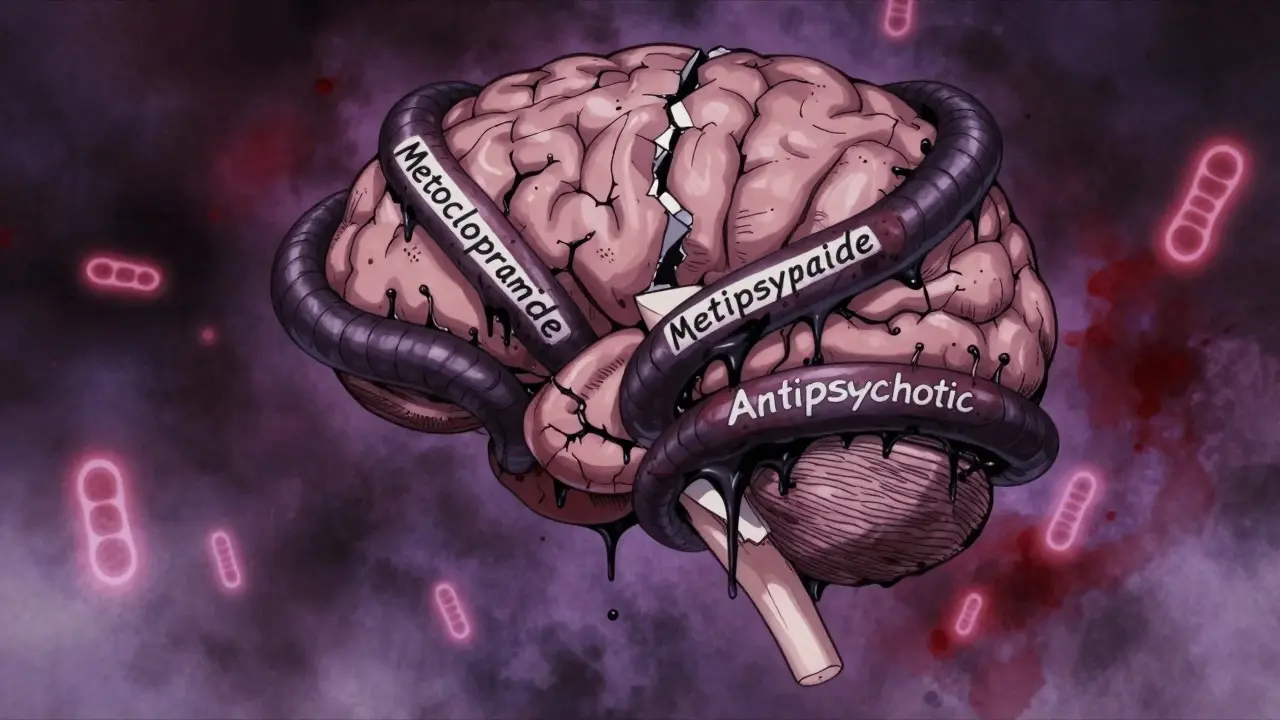
Neuroleptic Malignant Syndrome Risk Assessment Tool
Drug Interaction Risk Assessment
This tool assesses your personal risk for neuroleptic malignant syndrome (NMS) from combining metoclopramide with antipsychotic medications. NMS is a life-threatening condition that requires immediate medical attention.
Combining metoclopramide with antipsychotic medications isn't just a mild drug interaction-it’s a potentially deadly one. If you or someone you know is taking both, you need to understand the real risk: neuroleptic malignant syndrome (NMS). This isn’t a theoretical concern. It’s a life-threatening condition that shows up suddenly, worsens fast, and can kill if not caught immediately. The FDA has warned doctors directly: avoid metoclopramide in patients already on antipsychotics. Yet, this combo still gets prescribed. Why? Because many providers don’t realize how dangerous it is-or they think the benefits outweigh the risks. They’re wrong.
What Metoclopramide Does to Your Brain
Metoclopramide, sold under brand names like Reglan and Gimoti, was designed to help with nausea and slow stomach emptying. It works by blocking dopamine receptors in the gut and in a part of the brain called the chemoreceptor trigger zone. That’s why it helps with vomiting. But dopamine isn’t just about nausea. It’s also critical for movement, mood, and muscle control. When you block dopamine in the brain, especially in the basal ganglia, you mess with motor pathways. That’s why metoclopramide can cause tremors, stiffness, and involuntary movements-even in people who’ve never taken an antipsychotic.The FDA added a Boxed Warning to metoclopramide in 2009 because of tardive dyskinesia-a permanent, disfiguring movement disorder. The risk goes up the longer you take it. That’s why it’s not supposed to be used for more than 12 weeks. But here’s the kicker: when you add an antipsychotic on top, you’re doubling down on dopamine blockade. Antipsychotics like haloperidol, risperidone, and olanzapine are designed to block dopamine in the brain to treat psychosis. So now you’ve got two drugs hitting the same target, from two different angles. That’s not synergy-it’s overload.
What Is Neuroleptic Malignant Syndrome?
NMS isn’t just a bad reaction. It’s a medical emergency. It happens when dopamine receptors in the brain are blocked too hard, too fast. The body can’t regulate temperature, muscle tension, or autonomic functions anymore. The classic signs? Four things you can’t ignore:- High fever-often above 102°F (39°C)
- Severe muscle rigidity-like a statue, even when you try to move
- Confusion, agitation, or loss of consciousness
- Unstable blood pressure, fast heart rate, sweating-signs your autonomic nervous system is failing
It usually starts within days to weeks of starting or increasing either drug. But sometimes, it hits after just one dose if the person is already vulnerable. Creatine kinase (CK) levels spike because muscles are breaking down. Kidneys can fail. You can die within 24 to 72 hours if treatment doesn’t start immediately. There’s no lab test that confirms NMS-it’s diagnosed by symptoms and history. And if you’re on both metoclopramide and an antipsychotic, your risk jumps dramatically.
Why This Combo Is So Dangerous
It’s not just that both drugs block dopamine. There’s a second layer: pharmacokinetics. Metoclopramide is broken down by an enzyme called CYP2D6. Many antipsychotics-especially risperidone, haloperidol, and aripiprazole-block that same enzyme. So when you take them together, metoclopramide doesn’t get cleared from your body. It builds up. Your blood levels can double or triple. That means even a standard 10mg dose of metoclopramide can act like 20mg or 30mg. You’re not just doubling the effect-you’re multiplying it.And it gets worse. Some people have a genetic variation that makes them slow metabolizers of CYP2D6. That’s about 7% of the population. If you’re one of them and you’re on an antipsychotic that inhibits CYP2D6? You’re sitting on a time bomb. The FDA and NCBI both warn that people with kidney problems or this genetic profile are at highest risk. And many of those people are already on antipsychotics-people with schizophrenia, bipolar disorder, or severe depression with psychosis. They’re the exact group doctors are still prescribing metoclopramide to.
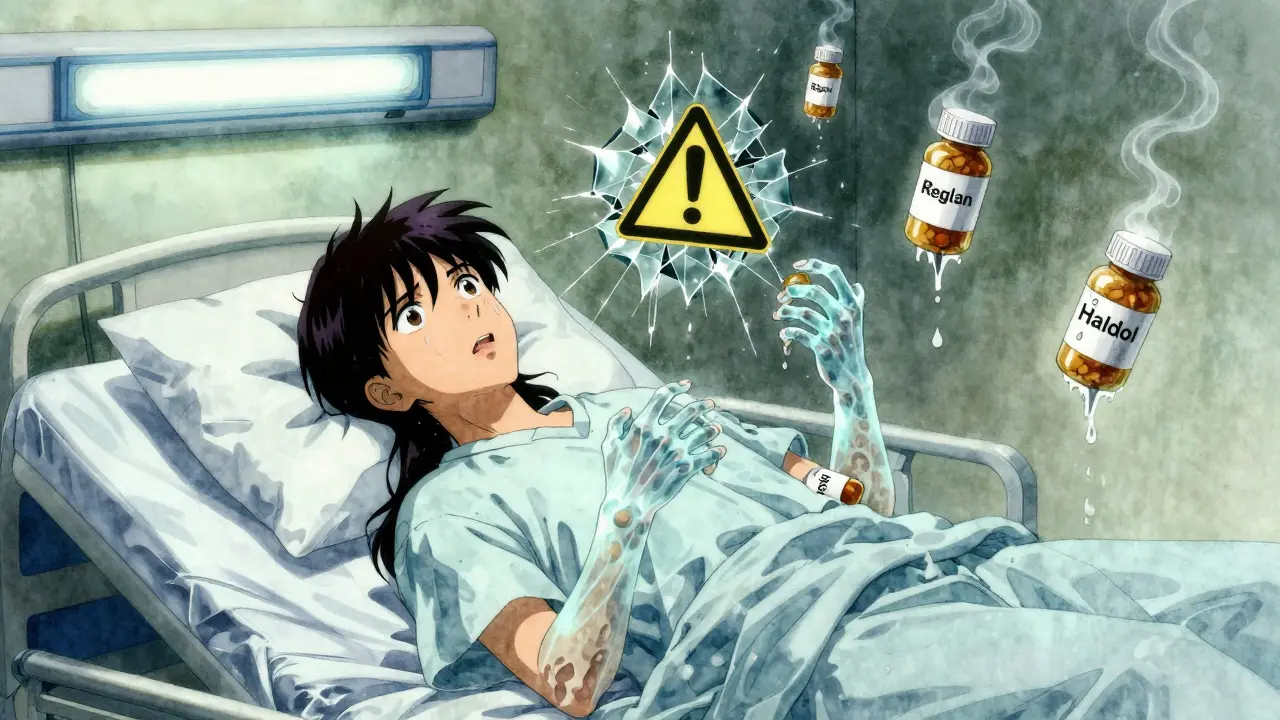
What Other Drugs Are Safe?
You don’t need metoclopramide to treat nausea or gastroparesis. There are safer options that don’t touch dopamine at all.- Ondansetron (Zofran): Blocks serotonin, not dopamine. Safe with antipsychotics.
- Prochlorperazine (Compazine): Also blocks dopamine, but it’s an antipsychotic itself-so it’s not safer. Avoid.
- Promethazine (Phenergan): Works on histamine and serotonin. Lower risk than metoclopramide, but can still cause sedation and low blood pressure.
- Granisetron: Another serotonin blocker. Good for chemo-induced nausea.
- Methylprednisolone: Sometimes used for nausea in palliative care. No dopamine effect.
For gastroparesis, alternatives include erythromycin (an antibiotic that also stimulates stomach motility) or dietary changes like small, low-fat meals. Gastric pacing devices are an option for severe cases. The point isn’t to find a perfect substitute-it’s to avoid dopamine blockers entirely if you’re already on antipsychotics.
Who’s at Highest Risk?
This isn’t a risk for everyone. But certain people are walking into a trap without knowing it:- Patients with schizophrenia or bipolar disorder on antipsychotics
- People with Parkinson’s disease-metoclopramide is contraindicated here because it worsens symptoms
- Those with a history of movement disorders, even if it was years ago
- People with kidney disease-metoclopramide builds up faster
- Older adults-slower metabolism, more sensitive to dopamine effects
- Patients on SSRIs like fluoxetine or paroxetine-these also inhibit CYP2D6
One study found that 1 in 10 patients on metoclopramide developed movement disorders within 3 months. That’s not rare. That’s common enough to be predictable. And when you add an antipsychotic? The numbers aren’t published because it’s so dangerous that most doctors don’t even try it anymore.
What Should You Do If You’re Taking Both?
If you’re on metoclopramide and an antipsychotic right now, don’t stop either abruptly. That can trigger withdrawal or rebound psychosis. But do this:- Call your doctor or pharmacist immediately. Tell them you’re on both drugs.
- Ask: "Is there a safer alternative for my nausea or stomach issue?"
- Request a full medication review. List every pill, patch, or injection you take.
- Ask about your CYP2D6 metabolism status-if it’s been tested.
- If you develop muscle stiffness, fever, confusion, or unexplained sweating-go to the ER. Say: "I think I might have NMS. I’m on metoclopramide and [name of antipsychotic]."
Doctors sometimes dismiss symptoms as "side effects" or "anxiety." But NMS doesn’t look like anxiety. It looks like your body is shutting down. If you’re not heard, go to the ER. Bring your medication list. Don’t wait.
Why Is This Still Happening?
You’d think after the FDA’s warning, after the Boxed Warning, after decades of case reports, this would be a non-issue. But it’s not. Why?First, metoclopramide is cheap. Generic. Easy to prescribe. Many doctors don’t know the full risks because they never learned them in medical school. Second, patients with gastroparesis often have diabetes or post-surgical issues. They’re in pain. They’re vomiting. The doctor sees a desperate patient and reaches for the fastest fix. Third, psychiatric patients are often treated by specialists who don’t manage GI issues-and GI specialists don’t always know the psychiatric meds their patients are on. Communication breaks down.
But the real reason? Fear. Doctors fear being sued for not treating nausea. They fear patients leaving angry. They fear being seen as "not caring." So they prescribe the easy drug. They don’t take the time to find the safer one. And someone pays the price.
What’s the Bottom Line?
Metoclopramide and antipsychotics don’t just interact-they collide. The result can be NMS: a condition that kills 10% to 20% of people who get it. The FDA says avoid it. The research says avoid it. The clinical guidelines say avoid it. Yet, it still happens. If you’re on either drug, ask about the other. If you’re on both, get off one-safely, under supervision. There are alternatives. You don’t need to risk your life for a quick fix.This isn’t about being paranoid. It’s about being informed. Your brain controls your movement, your temperature, your heartbeat. When two drugs block dopamine together, they don’t just add up-they explode. And no one should have to survive that.

Uju Megafu
January 19, 2026 AT 13:14This is why I can't trust doctors anymore. I had a friend on Reglan and risperidone for years - she started twitching like she was possessed, and her doctor just called it "stress." She ended up in the ICU for three weeks. Now she has permanent facial tics. If this isn't medical malpractice, I don't know what is. Someone needs to sue every pharmacy that dispenses this combo. 🤬
Roisin Kelly
January 21, 2026 AT 12:31Obviously the pharmaceutical companies are hiding this. They know people on antipsychotics are easy targets - depressed, isolated, no one’s checking their meds. And Reglan? Cheap. Profitable. Who cares if you die? The system is designed to kill the vulnerable. I’m not even surprised anymore. 😒
lokesh prasanth
January 22, 2026 AT 09:35Dopamine blockade = motor chaos. Simple. Metoclopramide + antipsychotic = double tap on nigrostriatal pathway. No mystery. Just bad pharmacology. 😴
Glenda Marínez Granados
January 23, 2026 AT 05:36So let me get this straight... we have a drug that causes permanent facial tics, and we still give it to people who already take brain-slowing meds? 🤡
And the excuse is "it's cheap"? Bro, we're in 2025. We can afford not to kill people for $2.50. 😒
Alex Carletti Gouvea
January 25, 2026 AT 03:22Why are we even talking about this? In America, we have better alternatives. If you're taking metoclopramide with antipsychotics, you're probably not even a real patient - you're some foreigner getting prescriptions from sketchy clinics. We don't do this here. 🇺🇸
Philip Williams
January 25, 2026 AT 18:26This is an excellent, meticulously researched breakdown. The pharmacokinetic interaction via CYP2D6 inhibition is particularly critical and often overlooked in clinical practice. I’ve reviewed multiple case studies where NMS developed within 48 hours of co-prescription - all preventable. This should be mandatory reading for all prescribers.
Thank you for highlighting the systemic failures in communication between psychiatric and GI specialists. That gap is lethal.
Ben McKibbin
January 26, 2026 AT 08:27I’ve seen this play out in the ER too many times. A 68-year-old diabetic with gastroparesis gets Reglan because the GI doc didn’t know she was on olanzapine. Three days later, she’s rigid, feverish, and confused. The family blames the hospital. But the real failure? No one checked the med list. No one asked about psychiatric meds.
It’s not malice - it’s fragmentation. We’ve turned healthcare into a series of silos. Someone needs to build bridges. And maybe, just maybe, electronic health records should auto-flag this combo. Like, a big red screaming warning. Not a tiny footnote.
Rod Wheatley
January 26, 2026 AT 23:02My mom was on metoclopramide for gastroparesis after her gastric bypass - and she was on sertraline. She didn’t get NMS, but she got this awful, uncontrollable jaw clenching that lasted for months. We didn’t connect it until she mentioned it offhand: "I’ve been clenching since I started that nausea pill."
Her doctor said, "Oh, that’s just a side effect." Like it was normal. It wasn’t. It was a warning sign. We switched her to ondansetron, and within two weeks, it vanished.
PLEASE - if you’re on any antipsychotic or SSRI, and your doctor prescribes Reglan? Say no. Ask for Zofran. It’s not harder. It’s not more expensive. It’s just safer. Don’t let "it’s just a side effect" be the reason you lose your mobility - or your life.
Ashok Sakra
January 27, 2026 AT 07:37my cousin died from this. he was on risperidone and took reglan for stomach. he just stopped breathing one night. they said it was heart failure. but i know. i know it was this. why do they still sell this? why??
Andrew Rinaldi
January 27, 2026 AT 19:04It’s heartbreaking how often preventable deaths happen because of poor communication - not malice, not greed, just systemic neglect. The fact that this combo still slips through cracks means we need better interoperability between mental health and primary care systems.
But I also think we need to stop blaming doctors entirely. Many of them are overwhelmed, underpaid, and trained on outdated protocols. The solution isn’t outrage - it’s better tools, better alerts, and better training.
Let’s channel this anger into advocacy. Push for CYP2D6 testing to be standard. Push for EHR flags. Push for mandatory med reconciliation at every visit.
We can fix this. But only if we stop screaming and start building.