
When you pick up a generic pill at the pharmacy, you might wonder: is this really the same as the brand-name drug? The answer isn’t as simple as "yes" or "no." It starts with something called pharmaceutical equivalence - and understanding this concept changes how you think about generics entirely.
What Pharmaceutical Equivalence Actually Means
Pharmaceutical equivalence is the baseline rule that every generic drug must meet before it can even be sold in the U.S. According to the FDA, two drugs are pharmaceutical equivalents if they contain the same active ingredient, in the same amount, in the same dosage form, and by the same route of administration. That means if your brand-name pill is a 10 mg tablet taken by mouth, the generic must also be a 10 mg tablet taken by mouth with the exact same active ingredient.
This doesn’t mean the pills look identical. Generics can be a different color, shape, or size. They can have different fillers, dyes, or coatings - these are called excipients. But the core medicine inside? That has to be identical. The FDA requires manufacturers to prove this using high-performance liquid chromatography (HPLC), a lab test that measures the active ingredient within ±5% of the labeled amount. If it’s off by more than that, the drug doesn’t pass.
Think of it like baking cookies. Two batches can use different types of chocolate chips or sprinkles, but if the flour, sugar, and butter are exactly the same, they’re still the same cookie. Pharmaceutical equivalence is about the core recipe - not the decoration.
How It Fits Into the Bigger Picture
Pharmaceutical equivalence is just the first step in a three-part system the FDA uses to approve generics. The next step is bioequivalence. This is where things get more interesting.
Bioequivalence asks: does the generic drug get absorbed into your bloodstream at the same rate and amount as the brand-name version? The FDA says yes - if the amount of drug in your blood (measured as AUC and Cmax) falls between 80% and 125% of the brand-name drug. That range isn’t arbitrary. It accounts for normal differences in how people’s bodies process medicine - from digestion speed to liver function.
But here’s the catch: pharmaceutical equivalence doesn’t guarantee bioequivalence. Two drugs can have identical active ingredients but behave differently in the body. For example, if a brand-name drug uses a special slow-release coating, and the generic uses a cheaper version that dissolves too fast, the active ingredient might spike in your blood too quickly. That’s why bioequivalence studies are mandatory.
The third and final layer is therapeutic equivalence. This is the gold standard. A drug rated "AB" in the FDA’s Orange Book means it’s therapeutically equivalent - it works the same way, with the same benefits and risks. But not all generics get that rating. Some are labeled "BX" or "BZ," meaning there’s not enough evidence to confirm they’re interchangeable. This often happens with complex drugs like inhalers, injectables, or topical creams where delivery matters as much as the ingredient itself.
Why This Matters for Patients
Most people assume that if a generic is approved, it’s a perfect copy. But the truth is more nuanced. For 90% of drugs - especially common ones like blood pressure pills, statins, or antibiotics - pharmaceutical and bioequivalence standards are more than enough. Millions of patients switch to generics every day without issue.
But for certain medications, even small differences matter. Take warfarin, a blood thinner with a narrow therapeutic index. A 5% change in how much drug reaches your bloodstream could mean the difference between a clot and a bleed. That’s why doctors often stick with the same brand for patients on warfarin, even if a generic exists. The FDA doesn’t block generics here - it just flags them with special warnings.
Another hidden issue? Excipients. These inactive ingredients can cause reactions. One 2022 survey found that 87% of pharmacists had seen at least one patient react to a filler in a generic - usually a dye, preservative, or lactose-based binder. For people with allergies or sensitivities, switching generics can trigger rashes, stomach upset, or even breathing issues. That’s why some patients are told to avoid certain generics, even if they’re "AB" rated.
How Pharmacists Use This Info
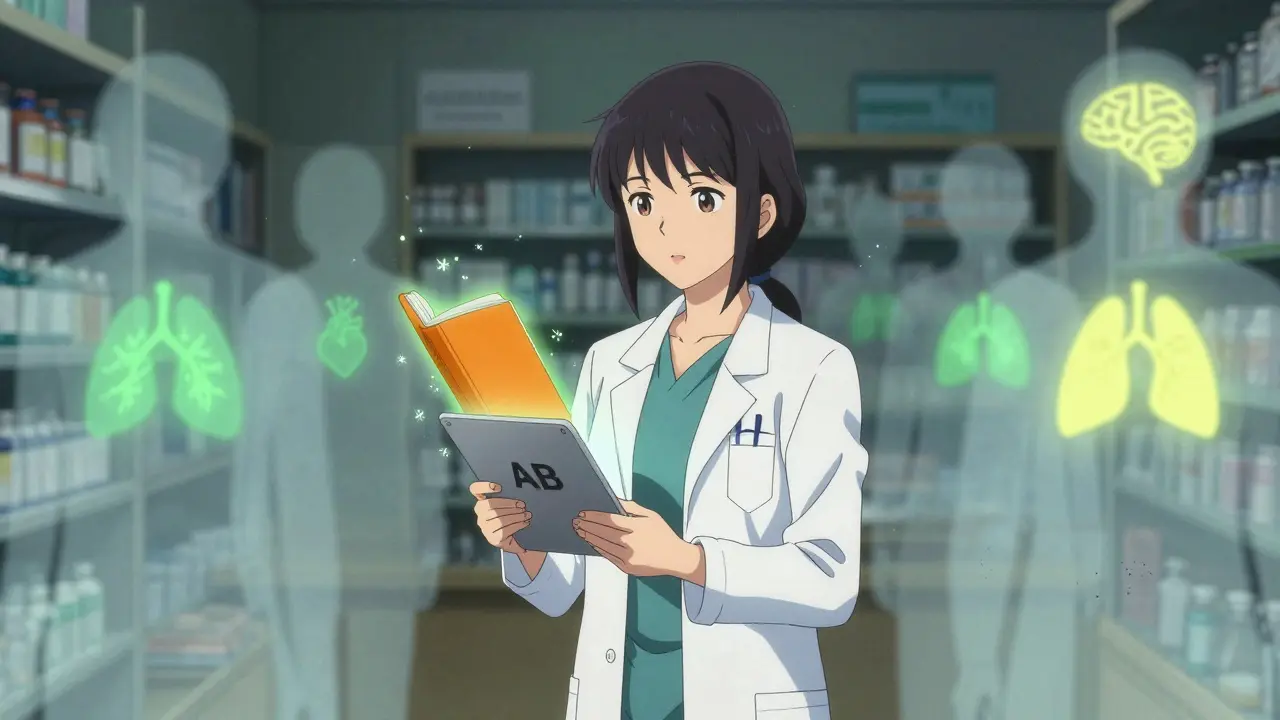
When you hand your prescription to a pharmacist, they don’t just grab the cheapest pill off the shelf. They check the FDA’s Orange Book - an official list updated monthly - to see if the generic is rated "AB." If it is, they can substitute it automatically, unless your doctor says "do not substitute." In U.S. hospitals, 97% have formal policies requiring this check.
But here’s where confusion sets in. A 2023 Kaiser Family Foundation survey found that 42% of patients believed generics contain only 80% of the active ingredient. That’s wrong. The 80-125% range refers to how much of the drug enters your bloodstream - not how much is in the pill. The pill itself contains 100% of the labeled amount. The variability comes from how your body absorbs it.
That’s why pharmacists are trained to explain the difference. A good pharmacist will say: "This generic has the same medicine as the brand, in the same dose. Your body might absorb it slightly differently, but it’s been tested to work the same way."
What’s Changing in 2026
The FDA isn’t resting on its standards. In 2023, it launched the Complex Generic Drug Product Development program to tighten requirements for tricky drugs like inhalers, patches, and injectables. These products don’t just need the right ingredient - they need the right delivery system. A generic inhaler that sprays differently, even with the same active ingredient, might not deliver the medicine to the lungs properly.
By 2027, the FDA expects to start using advanced tools like Raman spectroscopy and X-ray powder diffraction to analyze the physical structure of pills. This lets them see if the drug crystals inside the tablet are arranged the same way as the brand-name version. Small differences in crystal shape can affect how fast the drug dissolves - and that affects how well it works.
Also, in 2024, the FDA proposed a new rule requiring manufacturers to disclose more details about excipients. Right now, you have to read the fine print on the package insert. Soon, that info might be easier to find online. For patients with allergies, this could be a game-changer.

The Big Picture: Savings and Safety
Pharmaceutical equivalence isn’t just about science - it’s about access. Since the Hatch-Waxman Act passed in 1984, generics have saved the U.S. healthcare system over $2.2 trillion. On average, a generic saves you $1,008 per prescription. In 2023, 90% of all prescriptions filled were for generics. That’s not luck. It’s because the system works.
But it only works if we understand the rules. A generic isn’t "inferior." It’s a scientifically validated alternative. And when it’s rated "AB," you can trust it. For most drugs, it’s just as safe and effective - often cheaper, and always approved by the same agency that checks the brand-name versions.
The key is knowing when to ask questions. If you’re on a drug for epilepsy, thyroid disease, or blood thinning, talk to your doctor before switching. If you’ve had side effects from a generic before, tell your pharmacist. And if you’re unsure, check the Orange Book rating - it’s public, free, and updated monthly.
What You Should Do
- Ask your pharmacist if your generic is rated "AB" in the FDA’s Orange Book.
- Don’t assume all generics are the same - different manufacturers can make different versions.
- If you have allergies, ask about excipients - especially lactose, dyes, or gluten.
- For critical medications (like warfarin, levothyroxine, or epilepsy drugs), stick with the same brand or generic unless your doctor says otherwise.
- Use the FDA’s online Orange Book tool to look up your drug’s rating - no login needed.
Are generic drugs always as good as brand-name drugs?
For most drugs, yes - if they’re rated "AB" by the FDA. Pharmaceutical equivalence ensures they contain the same active ingredient in the same amount. Bioequivalence studies prove they work the same way in the body. But for complex drugs like inhalers or injectables, or for drugs with a narrow therapeutic index (like warfarin), small differences in delivery or absorption can matter. Always check the FDA’s Orange Book rating and talk to your pharmacist or doctor if you’re unsure.
Why do some generics cost more than others?
Cost differences between generics usually come down to manufacturing, supply, and competition. A generic made by a newer manufacturer might be cheaper than one from an established company. Sometimes, if only one company makes a generic (due to patent or manufacturing complexity), prices stay higher. It’s not about quality - it’s about market dynamics. The FDA requires all approved generics to meet the same standards, regardless of price.
Can I switch between different generic brands?
For most people, yes. If both generics are rated "AB," they’re considered interchangeable. But for some patients - especially those on narrow therapeutic index drugs - switching between generics can cause side effects. This isn’t because one is "bad," but because different manufacturers use slightly different excipients or manufacturing processes. If you notice changes in how you feel after switching, tell your doctor. They may recommend sticking with one brand.
Do generics have the same side effects as brand-name drugs?
The active ingredient causes the same side effects. But sometimes, inactive ingredients (excipients) in generics can trigger new reactions - like rashes, stomach upset, or headaches - especially in people with allergies. If you’ve never had side effects on the brand-name drug but do after switching to a generic, the excipients could be the cause. Your pharmacist can help identify which one might be triggering it.
How do I know if my generic is approved by the FDA?
All approved generics are listed in the FDA’s Orange Book, which is free to search online. You can look up your drug by name and see its rating: "AB" means it’s therapeutically equivalent. If it’s not listed, it’s not approved. Avoid buying generics from unregulated online pharmacies - even if they look real. Only use U.S.-approved products sold in licensed pharmacies.
Pharmaceutical equivalence is the foundation of the modern generic drug system. It’s not perfect, but it’s rigorously tested, transparent, and backed by science. When you choose a generic, you’re not choosing a compromise - you’re choosing a proven, safe, and affordable alternative. Just make sure you know what you’re getting.


Allison Priole
March 21, 2026 AT 15:26so like, i switched my blood pressure med to generic last year and honestly? i felt weirder. not sick, just... off. like my brain was slow-mo for a week. i thought it was stress, but then i read about excipients and realized the generic had this weird dye in it. switched back and boom, normal. turns out my body’s picky. weird, right? 😅
Nishan Basnet
March 22, 2026 AT 15:59The beauty of pharmaceutical equivalence lies not in its perfection, but in its rigor. The FDA’s ±5% tolerance isn’t a loophole-it’s a tribute to human biology. We are not machines; our absorption rates vary like tides. What matters is that the system accounts for this, not that it pretends to erase it. Generics aren’t cheap copies-they’re elegant approximations of science, refined by data, not dogma.
Desiree LaPointe
March 23, 2026 AT 17:25Oh wow, a 1000-page essay on how generics are basically the same. Groundbreaking. 🙄 Let me guess-next you’ll tell us water is wet and gravity exists. Meanwhile, my aunt had a seizure after switching generics because the filler changed. But sure, keep telling folks it’s all ‘scientifically validated.’
Casey Tenney
March 25, 2026 AT 08:13If you’re still worried about generics, you’re either rich or dumb. Get over it. The FDA doesn’t lie. Your life isn’t a Netflix drama. Take the pill. Save money. Be smart.
Sandy Wells
March 26, 2026 AT 09:06So you’re saying generics are fine unless you’re on warfarin or have allergies or the crystal structure is off or the dye makes you break out? So basically they’re not fine at all. Thanks for the clarification.
Timothy Olcott
March 27, 2026 AT 12:21AMERICA MADE THIS SYSTEM. OTHER COUNTRIES JUST COPY IT. 🇺🇸💊 If you’re in India or Germany and you’re still scared of generics, maybe you should move here. We don’t mess around. FDA = God. End of story. 🚫🇨🇦🇪🇺
Jackie Tucker
March 29, 2026 AT 08:43How quaint. We’ve reduced the complexity of human physiology to a 3-tiered FDA checklist like it’s a fast-food menu. "AB" means you’re a good citizen. "BX" means you’re a risk-taker. And if you have a reaction? Well, that’s just your body’s failure to conform to the algorithm. How very postmodern.
Thomas Jensen
March 30, 2026 AT 15:12They’re lying. I know this. The FDA doesn’t test the actual absorption in real people. They use 20 healthy college kids in a lab. Real people? Diabetics. Elderly. People on 7 meds? Nah. They just slap a stamp on it and call it good. And the manufacturers? They change the filler every 6 months. No one tracks it. I’ve seen it. I work in pharmacy. They know. They just don’t tell you. 🤫
Natali Shevchenko
March 30, 2026 AT 18:59It’s funny how we treat medicine like a commodity when it’s the most intimate thing we put inside our bodies. We don’t ask how the car engine was built, but we demand to know every crystal lattice of our pills. Maybe the real problem isn’t the generic-it’s that we’ve lost trust in systems that were built to protect us. We want control, so we obsess over dyes and coatings. But what if the real answer is learning to trust again? Not blindly-but with awareness.
matthew runcie
March 31, 2026 AT 13:15Appreciate the breakdown. I’ve been on generics for 12 years. No issues. But I always check the Orange Book. Smart move. Simple rule: if it’s AB, I’m good. If I feel weird, I call my pharmacist. Done. No drama.
Johny Prayogi
April 1, 2026 AT 12:26Yessss this is so needed!! 🙌 I work in a rural clinic and 70% of our patients switch to generics because they can’t afford the brand. I’ve seen lives saved because of this system. Yes, there are edge cases-but the wins? Overwhelming. Stop fear-mongering. The science is solid. 💪💊