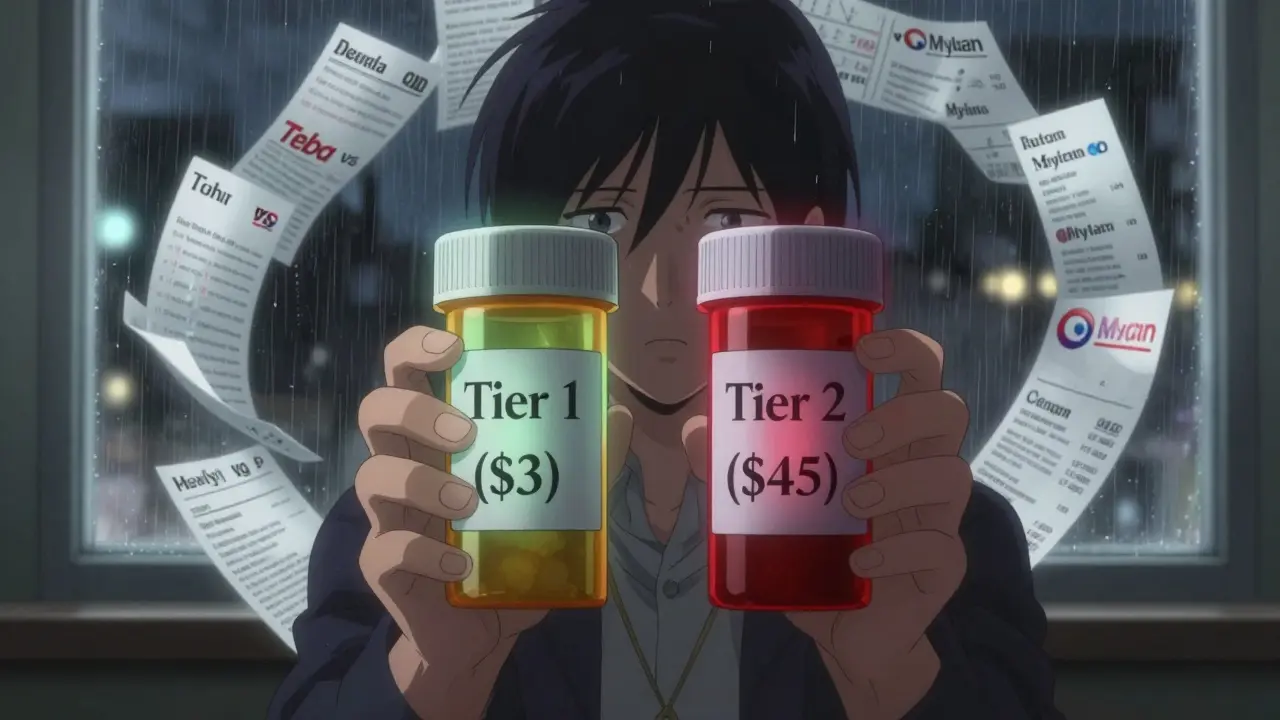
When you’re switching health plans, one of the most overlooked but costly mistakes is ignoring how your generic medications are covered. You might think all generics are the same - same active ingredient, same price. But that’s not true. Generic drug coverage can vary wildly between plans, and getting it wrong could cost you hundreds - or even thousands - of dollars a year.
Why Generic Drug Coverage Matters More Than You Think
Generics make up 90% of all prescriptions filled in the U.S., but they only account for about 23% of total drug spending. That’s because they’re cheap - really cheap. A 30-day supply of generic metformin might cost $3 at one plan and $45 at another. The difference isn’t the drug. It’s how the plan structures its formulary - the list of drugs it covers and at what price.
Most health plans use tiered formularies. Think of them like levels in a video game: the lower the tier, the less you pay. Tier 1 is almost always reserved for generic drugs. But even within Tier 1, prices can change based on your plan type, state rules, or whether the plan waives your deductible for generics.
How Formulary Tiers Work - And Why They’re Confusing
There are three main types of formulary structures you’ll run into:
- 3-tier plans: Generic (Tier 1), brand-name (Tier 2), specialty (Tier 3). Copays for generics are usually $5-$10.
- 4-tier plans: The most common. Tier 1 = generics ($3-$20), Tier 2 = preferred brands, Tier 3 = non-preferred brands, Tier 4 = specialty drugs.
- 5-tier plans: Mostly Medicare Advantage. Tier 1 = preferred generics ($0-$10), Tier 2 = non-preferred generics ($20-$40), then brand, specialty, and high-cost specialty.
Here’s the catch: a drug labeled "Tier 1" in one plan might be "Tier 2" in another - even if it’s the exact same generic. Why? Because plans can prefer certain manufacturers. If your metformin is made by Manufacturer A and your new plan only covers Manufacturer B, you’ll pay more. That’s not a mistake. That’s how formularies work.
Plan Types That Change Everything
Not all plans are created equal. Here’s how your plan type affects your generic drug costs:
- Marketplace plans (Silver SPD): These are the best for people on generics. Since 2014, federal rules require Silver Standardized Plans to waive the deductible for Tier 1 generics. You pay a flat $20 copay - no matter how much you’ve spent on medical care. This alone can save you $1,500+ a year if you take regular meds.
- High-deductible health plans (HDHPs): These look cheap on paper, but they’re risky for generic users. Unless it’s a Silver SPD plan, you must meet your full medical deductible before any drug coverage kicks in. So if your deductible is $3,000 and you need $500 worth of generics, you pay $500 out of pocket. No help until you hit $3,000.
- Medicare Part D: The base deductible in 2023 was $505, but most plans have lower or no deductible for generics. Preferred generics often cost $0-$10. But if your plan moves your drug to a higher tier, your cost jumps. And remember - Medicare Advantage (MA-PD) plans often bundle drug coverage with medical benefits, which can be cheaper than standalone Part D plans.
- Employer-sponsored plans: These vary wildly. Some charge $5 for generics before the deductible. Others charge $15 after. Check your plan’s document - don’t trust HR’s summary.
State Rules Can Make or Break Your Costs
Where you live matters more than you think. California requires a $85 outpatient deductible before generics are covered - and then you pay 20% coinsurance up to $250. In New York? No deductible. Just a $0-$7 copay. DC has a $350 separate drug deductible. These rules override what your plan says.
Some states even mandate $0 copays for certain drugs. California’s SB 1423 made insulin free. New York does the same for several chronic condition meds. If you’re switching plans within the same state, check your state’s pharmacy laws. They can give you better coverage than your plan does.
What You Need to Check Before Switching
You can’t just look at the monthly premium. You need to dig into your meds. Here’s a step-by-step checklist:
- Get the full formulary - not just a summary. Look for your exact drug name AND manufacturer. If your current generic is made by Teva and the new plan only covers Mylan, you’re in trouble.
- Check the tier. Is it Tier 1? If yes, what’s the copay? Is there a deductible? Does it apply to generics?
- Verify your pharmacy network. If your local pharmacy isn’t in-network, you might pay 3-4 times more. Mail-order is often cheaper - but only if you’re allowed to use it.
- Calculate your annual cost. Multiply your monthly copay by 12. Add any deductible you’d have to meet. Compare that to your current plan. Don’t forget: if you take three meds, multiply by three.
People who follow all four steps reduce unexpected drug costs by 73%, according to CMS data. Those who skip even one? They’re gambling.
Tools That Actually Work
Don’t guess. Use tools:
- Medicare Plan Finder (medicare.gov): Type in your drugs. It shows costs across all Part D plans. Used by over 4 million people in 2022.
- Healthcare.gov’s plan selector: Filters plans by your medications. Great for marketplace plans.
- Insurer-specific formulary tools: Most insurers have a search tool on their website. Accuracy ranges from 78% to 96%. Always use the one from your plan provider.
These tools let you plug in your exact drugs - including strength and manufacturer - and see real costs. No more surprises.
Common Mistakes People Make
Here’s what goes wrong:
- Assuming "generic" means "same price". It doesn’t. Manufacturer matters.
- Ignoring mail-order options. Getting 90-day supplies by mail can cut costs by 30-50%.
- Not checking for formulary changes. Plans change their lists every year. Your drug might be covered this year - gone next.
- Forgetting about specialty generics. Some generics (like those for MS or rheumatoid arthritis) are classified as specialty drugs. They’re often Tier 4 or 5 - meaning 20-30% coinsurance and $200+ copays.
Reddit users reported 147 cases in 2023 where switching plans led to a $50 generic suddenly costing $120 - all because the manufacturer changed. That’s not rare. It’s standard.
What’s Changing in 2025 and Beyond
Big changes are coming:
- Medicare Part D will cap out-of-pocket drug costs at $2,000 in 2025. That’s huge for people on multiple generics.
- Insulin is now capped at $35/month under the Inflation Reduction Act - no matter your plan.
- Formulary tiers are getting more complex. By 2026, some plans may split generics into 3 or 4 tiers based on therapeutic equivalence - meaning even "the same" drug could cost more if it’s "less preferred."
These changes make it even more important to check your plan every year. Don’t assume last year’s choice is still the best.
The Bottom Line
Switching health plans without checking your generic drug coverage is like buying a new car without checking the fuel efficiency. You might save on the monthly payment, but you’ll pay more at the pump.
If you take even one generic medication regularly - for blood pressure, diabetes, cholesterol, thyroid, or depression - your formulary tier is more important than your deductible. Look at the copay. Check the manufacturer. Confirm the pharmacy. Use the tools. Do the math.
People who do this right save $700-$1,200 a year. That’s not a small amount. That’s a vacation. That’s your car payment. That’s peace of mind.
What’s the difference between a generic drug and a brand-name drug?
A generic drug has the same active ingredient, strength, dosage form, and route of administration as the brand-name version. It’s chemically identical. The only differences are the inactive ingredients (like fillers), packaging, and price - generics cost 80-85% less. Plans cover generics because they’re cheaper, not because they’re inferior.
Why does my generic drug cost more on my new plan?
Two reasons: either the manufacturer changed (your plan prefers a different maker), or the drug was moved to a higher tier. For example, if your metformin was Tier 1 on your old plan but is now Tier 2 on the new one, your copay might jump from $5 to $35. Always check the exact drug name and manufacturer on the new plan’s formulary.
Do all health plans cover the same generics?
No. Each plan creates its own formulary. A drug covered on Tier 1 by one insurer might be Tier 3 or not covered at all by another. Medicare Part D plans, marketplace plans, and employer plans all have different lists. You must compare them side by side using your specific medications.
Can I switch back if my new plan doesn’t cover my meds?
Usually, you can only switch plans during Open Enrollment (November 15-December 7 for Medicare, and November 1-January 15 for marketplace plans). But if you lose your current coverage, qualify for a special enrollment period (like moving or losing job-based insurance), or if your plan drops your drug mid-year, you may be able to switch. Always check your plan’s rules before enrolling.
Is there a way to get generics for free?
Some generics are free under certain conditions. Insulin is capped at $35/month for Medicare and most private plans. Some states (like California and New York) require $0 copays for certain chronic condition drugs. Also, many drug manufacturers offer patient assistance programs - especially for low-income people. Check NeedyMeds.org or the manufacturer’s website.
What if my doctor prescribes a brand-name drug instead of a generic?
Your plan may still cover it - but at a much higher cost. Ask your doctor if a generic version is available and appropriate. If not, ask them to file a "prior authorization" request with your insurer. Sometimes, the plan will approve the brand if you prove the generic doesn’t work for you. Otherwise, you’ll pay the full price.
Kathy Leslie
March 14, 2026 AT 17:25Just switched plans last year and didn’t check my generics. Ended up paying $80/month for metformin instead of $5. Learned the hard way. Always look at the formulary like it’s a contract you didn’t read. Not worth the stress.
Serena Petrie
March 16, 2026 AT 14:05Same. My $3 generic became $47. Never again.
Buddy Nataatmadja
March 18, 2026 AT 08:36As someone who’s lived in 5 countries, the US drug pricing chaos still blows my mind. In Canada, generics are $5 flat. In the UK, they’re free. Here? You need a spreadsheet, a lawyer, and a prayer.
rakesh sabharwal
March 19, 2026 AT 03:46The fundamental issue here is the pathological fragmentation of pharmaceutical formularies. One cannot reasonably expect a layperson to navigate the ontological dissonance between therapeutic equivalence and commercial preference. The current system is not merely inefficient-it is epistemologically hostile to patient autonomy. The FDA’s bioequivalence standards are technically adequate, yet the perverse incentives embedded within PBMs and tiered formularies create a market for arbitrage that actively undermines public health outcomes. We are not dealing with a pricing problem-we are dealing with a structural failure of regulatory capture.
Moreover, the notion that "Tier 1" is a consistent category across payers is a myth perpetuated by industry PR. The real variable is manufacturer alignment with PBM rebate structures. If Teva doesn’t pay the right kickback, your metformin becomes Tier 2. This isn’t clinical decision-making. It’s corporate lobbying disguised as pharmacy benefits.
And don’t get me started on the Medicare Part D donut hole. The $2,000 cap in 2025 is a Band-Aid on a hemorrhage. The real solution is single-payer drug purchasing, full stop. Until then, we’re all just gambling with our insulin pens.
Also, mail-order pharmacies are not a "nice-to-have." They are a necessity. Three-month supplies reduce administrative overhead and increase adherence. Yet most insurers still treat them as optional. This is not patient-centered care. This is profit-maximization masquerading as healthcare.
The tools mentioned? Useless without granular API access to real-time formularies. The Medicare Plan Finder? Outdated by 3 weeks. The insurer’s tool? 78% accuracy? That’s not a tool-that’s a trap. We need open, standardized, real-time formulary feeds. Like the stock market, but for pills. And until Congress passes legislation mandating transparency, we’re all just guessing.
And yes-state laws matter. California’s SB 1423 should be federal law. Why should a diabetic in Texas pay $120 for insulin while one in NY pays $0? That’s not healthcare policy. That’s geographic discrimination.
TL;DR: This isn’t about smart shopping. It’s about systemic corruption. We need structural reform, not tips.
Elsa Rodriguez
March 19, 2026 AT 12:47I CRIED when I found out my antidepressant went from $5 to $67. I had to choose between meds and groceries. I’m not even mad. I’m just… tired. Why does this have to be so hard? 💔
Amisha Patel
March 20, 2026 AT 20:54Thanks for this. I’m switching plans next month and have 3 generics. Just printed the formularies and am comparing side by side. Took me 3 hours. Worth it.
Hugh Breen
March 21, 2026 AT 14:07Just dropped my kid off at college and helped her switch her plan. We spent 2 hours on the Medicare site. Found her $0 copay for her asthma med. She’s so relieved. 😊 You’re right-this stuff matters. And yeah, mail order saved us $200/month. 10/10 recommend. 🙌
mir yasir
March 23, 2026 AT 07:46It is a matter of considerable concern that the current paradigm of pharmaceutical formulary administration exhibits a profound disregard for equitable access. The variance in copayment structures across jurisdictions, compounded by the absence of federal standardization, constitutes a systemic inequity that disproportionately burdens low-income populations. One must question the ethical foundations of a system wherein a life-sustaining medication is contingent upon the arbitrary alignment of corporate rebates.
Furthermore, the reliance on consumer-driven tools-such as insurer-specific formulary search engines-is not only inadequate but fundamentally misleading. These platforms are not designed for transparency; they are optimized for retention. The 78% accuracy rate cited is not a feature-it is a flaw.
The solution lies not in individual diligence but in institutional reform. A centralized, publicly accessible, real-time formulary registry-modeled after the National Drug Code system-must be mandated. Until then, patients are left to navigate a labyrinth of obfuscation.
It is not laziness. It is not ignorance. It is design.
Byron Boror
March 24, 2026 AT 02:26Why are we even talking about this? Just buy American-made generics. If your plan doesn’t cover the right one, switch to a plan that does. Stop whining. This is America. We don’t need government handouts. We need better choices. And if you can’t afford it, get a better job.
Lorna Brown
March 25, 2026 AT 12:45It’s interesting how we treat medication like a commodity when it’s literally a matter of life and death. The fact that a diabetic’s access to insulin depends on which manufacturer a PBM favors… that’s not capitalism. That’s cruelty dressed up as policy.
I wonder if we’d be this okay with it if the drug was for children. Or veterans. Or cancer patients. We rationalize it because it’s "just generics." But they’re not just anything. They’re the difference between stability and collapse.
Maybe we need to stop calling them "generics" at all. Maybe we need to call them what they are: essential medicines.
Richard Harris
March 26, 2026 AT 01:31Used the healthcare.gov tool and found out my $12 pill is now $3.50. Just saved myself $100 a month. Took me 10 mins. Seriously, do this. It’s not hard. Just… do it. 😅