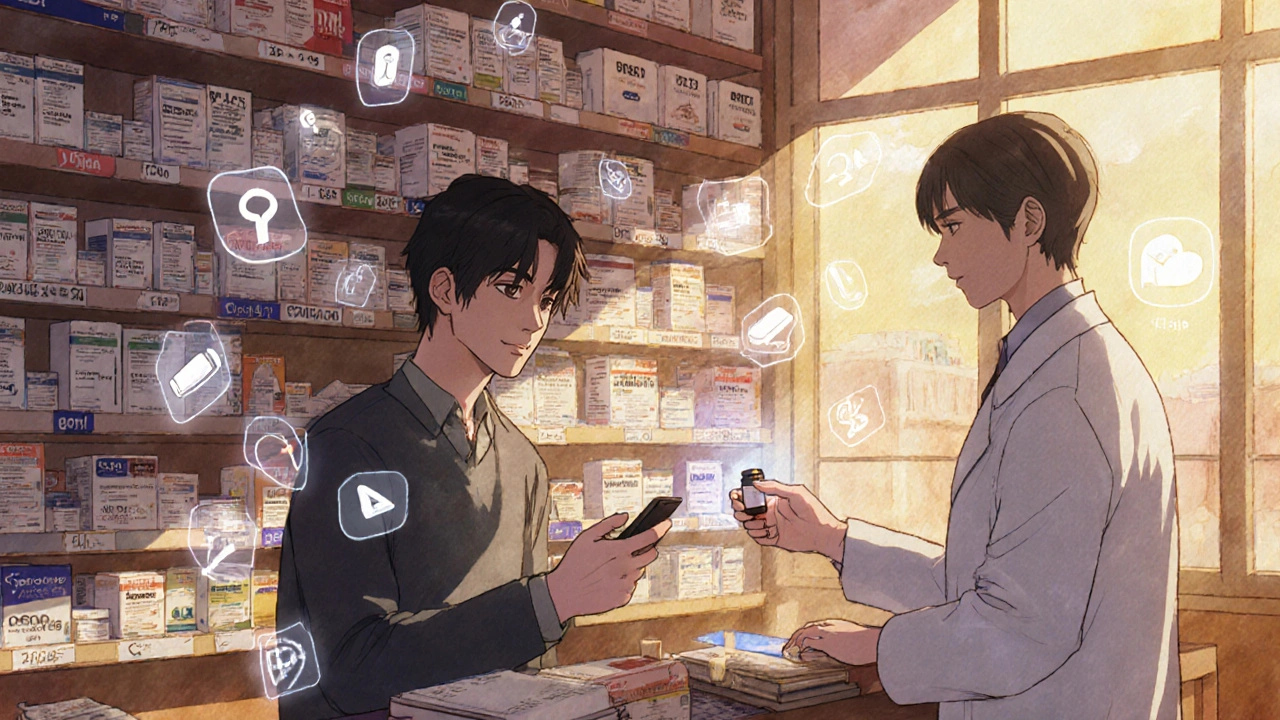
Imagine you’re on vacation in Spain, and your blood pressure medication runs out. Back home, you have a digital prescription. Instead of rushing to a local clinic or paying double for a brand-name pill, you walk into a Spanish pharmacy, scan your phone, and walk out with the exact generic version you take at home-no paperwork, no delays. This isn’t science fiction. It’s happening right now across the European Union.
How Cross-Border Pharmacy Services Actually Work
The EU’s cross-border pharmacy system isn’t about smuggling drugs or shady online pharmacies. It’s built on two secure digital tools: ePrescription and Patient Summaries. These are part of the eHealth Digital Service Infrastructure (eHDSI), also known as a secure EU-wide network connecting national health systems to allow electronic sharing of prescriptions and medical data. Since 2021, 27 EU and EEA countries have been using this system to let patients fill prescriptions abroad.Here’s how it works in practice. You get a digital prescription from your doctor in Germany. You travel to Austria. At the pharmacy there, the pharmacist logs into the eHDSI portal using your consent, pulls up your valid prescription from Germany, and dispenses the medication. No physical paper. No translation needed. The system even shows your allergy history and current meds in the pharmacist’s language via the Patient Summary.
This system isn’t optional-it’s mandatory under Directive 2011/24/EU. But here’s the catch: not every country uses it the same way. Only eight EU countries have full rules for how pharmacists should handle online prescriptions. That means your experience in France might be smooth, but in Poland, the pharmacist might still ask for a printed copy-even if the law says they shouldn’t.
Why Generic Drugs Are the Real Winner
The real power of this system isn’t convenience-it’s cost. Generic drugs are chemically identical to brand-name versions but cost 30% to 80% less. In countries like Germany and Sweden, generics make up over 70% of prescriptions. But in places like Greece or Portugal, patients often pay more because local pharmacies stock fewer generics or don’t stock them at all.With cross-border access, a patient in Italy can order a cheaper generic version of their diabetes drug from a pharmacy in the Netherlands, where it’s stocked in bulk and priced lower. This isn’t just a personal savings-it’s a pressure valve for strained public health budgets. The European Commission estimates that if cross-border generic access were fully utilized, EU healthcare systems could save up to €4.2 billion annually by 2030.
But here’s the problem: most people don’t know this is possible. A 2025 Eurobarometer survey found only 38% of EU citizens are aware they can get medications from another member state. In border towns like Aachen (Germany) and Maastricht (Netherlands), awareness hits 72%. That’s because people there have been doing it for years. In non-border areas, the system feels abstract. You need to know it exists before you can use it.
The Hidden Rules That Can Block You
Just because the system exists doesn’t mean it works for everyone. There are legal landmines.Take Ireland. If you try to use a prescription from a UK telehealth service-even if it’s from a licensed doctor-it will be rejected. Why? Because Ireland still treats the UK as a third country for prescription purposes. Even if the prescription has all the right details, pharmacists are legally required to verify the prescriber’s registration and the method of consultation. If it was done via video call from a UK-based app, it’s invalid.
Italy made a big change in February 2025: they replaced the old paper “bollino” sticker on prescriptions with a GS1 DataMatrix barcode. That barcode holds the prescription ID, drug name, dosage, and patient info. It’s scannable and secure. But if you’re from a country still using paper prescriptions, your barcode won’t exist. The Italian pharmacy won’t know what to do with it.
And then there’s Iceland. Until August 31, 2025, they weren’t connected to the eHDSI network. Now they are. But if you’re a tourist from Spain trying to fill a prescription in Reykjavik before that date, you’re out of luck. No digital transfer. No Patient Summary. You’d need a physical prescription and a translator.
What Pharmacists Are Dealing With
It’s not just patients who struggle. Pharmacists are on the front lines.They’re expected to know the drug names in five languages. A pill called “Metformin” in Germany might be sold as “Glucophage” in France, even though they’re the same. Some countries use different dosages. A 500mg tablet in Spain might be a 850mg tablet in Belgium. Pharmacists must check formulations, check for interactions, and make sure the drug isn’t restricted in their country.
Training is inconsistent. A 2025 EAEP study found pharmacists need about 40 hours of specialized training to handle cross-border prescriptions properly. But in many countries, they get two hours of online modules. Language barriers are real. A Romanian pharmacist might not know what “Lercanidipine” is called in Finnish. And if the Patient Summary is incomplete? That’s a safety risk.
Some pharmacies refuse to process foreign prescriptions altogether. Not because they’re breaking the law, but because they’re afraid of liability. If something goes wrong, who’s responsible? The doctor in Poland? The pharmacy in Sweden? The system doesn’t clarify that.
What’s Changing in 2025 and Beyond
The EU is pushing hard to fix these gaps. The new Critical Medicines Act requires drugmakers to report supply and demand data in real time across borders. If a generic blood thinner runs low in France, the system can automatically redirect stock from Germany or the Czech Republic.There’s also the European Shortages Medicines Platform (ESMP), launched in March 2025. It’s a live dashboard showing which drugs are in short supply where. Pharmacies can see it. Doctors can see it. Patients can, too-if they know how to find it.
By 2027, the system will expand to include lab results, hospital discharge summaries, and even medical images. Imagine a diabetic patient in Finland gets hospitalized in Portugal. The Portuguese ER doctor pulls up their full history-insulin doses, HbA1c levels, previous complications-all in Portuguese, automatically translated. That’s the goal.
But progress is slow. The General Pharmaceutical Council in the UK and similar bodies in other countries still prioritize local rules over EU-wide harmony. That creates confusion. One pharmacy follows EU law. The next follows national rules. Patients get mixed messages.
What You Need to Do to Use It
If you’re an EU citizen and you take regular medication, here’s what you need to do now:- Ask your doctor for a digital prescription. Make sure it’s issued through your country’s official e-prescription system.
- Check if your country is connected to eHDSI. All 27 EU/EEA countries are, but some still have glitches.
- Before traveling, log into your national health portal (like Sweden’s 1177.se or Germany’s eGK) and enable cross-border access for the countries you’re visiting.
- Carry a printed backup of your prescription and a list of your meds in English. Even if the system works, pharmacies might still ask for it.
- Know your drug’s generic name. If you take “Lipitor,” ask your doctor for the generic: “Atorvastatin.” That’s what you’ll find abroad.
Don’t wait until you’re out of pills. Test the system. Try filling a non-urgent prescription in a neighboring country. It’s legal. It’s safe. It’s cheaper.
What’s Still Broken
The system is powerful-but it’s not perfect.First, reimbursement is a mess. If you buy a generic drug in Belgium and come home, your national health insurer might refuse to refund you because “the drug wasn’t prescribed locally.” The law says you’re entitled to reimbursement equal to what you’d pay at home. But most insurers don’t know that.
Second, specialized drugs are still hard to get. Cancer meds, rare disease treatments, or injectables often aren’t stocked abroad. The system works best for common generics: blood pressure pills, diabetes drugs, antidepressants.
Third, the user interface is clunky. You have to log into your national portal, give consent, wait for approval, then find a pharmacy that accepts ePrescriptions. It’s not one-click. It’s five clicks, two logins, and a phone call to the pharmacy to confirm they can help.
And then there’s awareness. People don’t know this exists. They assume if they’re outside their home country, they’re on their own. That’s the biggest barrier-not technology, not law, but ignorance.
The Future Is Connected
The EU’s cross-border pharmacy system isn’t just about drugs. It’s about health equity. It’s about a retiree in rural Romania getting the same diabetes meds as someone in central Berlin. It’s about a student in Lisbon getting their birth control without having to return home for a prescription.By 2030, IQVIA predicts this system could reduce medication access gaps across the EU by up to 35%. But that only happens if citizens demand it. If patients stop accepting “we can’t help you” as an answer. If pharmacists demand better training. If governments stop treating digital health as optional.
The infrastructure is there. The laws are clear. The savings are real. The only thing missing is you using it.
Can I use my EU prescription in the UK after Brexit?
No. The UK is no longer part of the EU’s ePrescription system. UK pharmacies cannot fill EU digital prescriptions, and EU pharmacies cannot fill UK prescriptions unless they’re from a licensed UK doctor and meet strict documentation requirements. Travelers should carry a paper prescription and enough medication for their trip.
Are all generic drugs the same across EU countries?
The active ingredient is legally required to be identical. But fillers, coatings, and dosages can differ. A 10mg tablet in Spain might be 12.5mg in Finland. Always check the label and confirm with the pharmacist. If you’ve had reactions to a specific brand, ask for the exact formulation.
Do I need to pay upfront when buying abroad?
Yes. You pay the pharmacy directly at the local price. You can later apply for reimbursement from your home country’s health insurer, but only up to the amount you’d pay at home. Keep your receipt and prescription details.
What if my medication isn’t available in the country I’m visiting?
The system doesn’t guarantee availability. If your drug isn’t stocked, you may need to switch to an equivalent generic, get a new prescription locally, or return home. Always research drug availability before traveling. Use the European Medicines Agency’s website for cross-border drug equivalence guides.
Is my personal data safe when using ePrescription?
Yes. The eHDSI system uses encrypted, consent-based access. Your data isn’t stored in a central EU database. It stays in your home country’s system. The pharmacy only sees what you’ve authorized-your prescription and summary. You control how long and where your data is shared.
Can I use this service for controlled substances like painkillers?
Generally, no. Most EU countries restrict cross-border access to controlled substances like opioids, benzodiazepines, and stimulants. Even with a digital prescription, these are rarely dispensed abroad. Always check your home country’s rules and the destination country’s restrictions before planning.
How do I know if my pharmacy abroad accepts ePrescriptions?
Look for the official ePrescription logo (a green cross with a digital icon) on the pharmacy’s window or website. You can also check your national health portal-it often lists partner pharmacies in other EU countries. When in doubt, call ahead and ask: “Do you accept ePrescriptions from [your country] via eHDSI?”
Chuckie Parker
November 27, 2025 AT 17:22This EU nonsense is why America stays great. You think letting foreigners dictate your pharmacy rules is freedom? My grandma in Ohio doesn’t need some German algorithm deciding what medicine she gets. Stick to your own borders and stop exporting bureaucracy.
George Hook
November 27, 2025 AT 20:58I’ve been using this system for three years now-lived in Berlin, then moved to Lisbon. The first time I filled a prescription in Spain with my German ePrescription, I cried. Not because it was emotional, but because I realized how absurd it was that we ever needed paper slips and translators for something as basic as medicine. The infrastructure exists, the tech works, and the savings are real. The only thing holding it back is fear of change and lazy bureaucrats who’d rather print forms than click buttons. It’s not perfect, but it’s miles ahead of what we had.
jaya sreeraagam
November 28, 2025 AT 06:34As an Indian living in the US, I’ve seen how broken healthcare systems are everywhere. But this? This is beautiful. Imagine if India had this with Nepal or Bangladesh-people in rural areas could get life-saving meds without traveling 300km. The real win isn’t cost, it’s dignity. No one should have to choose between their health and their passport. Keep pushing this, EU. You’re doing something right. And yes, I know my spelling’s weird-I’m typing on my phone while waiting for my coffee. But the message? Crystal clear.
Katrina Sofiya
November 28, 2025 AT 09:41Dear fellow citizens of the European Union, thank you for building this. Truly. I know it’s not perfect, but the fact that a single mother in Bucharest can access her insulin from a pharmacy in Vienna without begging for paperwork is nothing short of revolutionary. This is what cooperation looks like. This is what compassion looks like. Please don’t let political noise drown out this quiet miracle. Share this with your friends. Tell your pharmacist. Advocate. You’re not just saving money-you’re saving lives.
kaushik dutta
November 29, 2025 AT 19:54The eHDSI framework is a paradigm-shifting vector for pharmaceutical equity, leveraging interoperable health data ecosystems under Directive 2011/24/EU. However, structural heterogeneity in national formularies and pharmacovigilance protocols introduces significant transactional friction. The absence of harmonized pharmacokinetic labeling-e.g., Metformin 500mg vs. Glucophage 850mg-is not merely a linguistic issue but a pharmacological divergence that demands standardized nomenclature protocols under WHO INN guidelines. Until we resolve this, we’re just digitizing confusion.
doug schlenker
November 30, 2025 AT 12:51I used to think this was just for tourists. Then my sister, who’s on antidepressants, got stuck in Croatia when her pills ran out. She called me panicked. I told her to try the ePrescription. She did. Walked into a pharmacy, scanned her phone, got her meds in 10 minutes. She didn’t even know how to explain it to the pharmacist-just showed the screen. That’s when I realized: this isn’t about policy. It’s about people. The system isn’t broken. We just haven’t told enough people it exists.
Olivia Gracelynn Starsmith
December 2, 2025 AT 05:59It’s not that complicated. Digital prescription. Scan. Get medicine. Save money. The real problem is people don’t know it’s an option. I told my cousin in Texas about this and he laughed. Said it sounded like sci-fi. I showed him the EU website. He’s now asking his doctor for an ePrescription for his next trip to Italy. Small wins. Start with one person. One prescription. One pharmacy. It adds up.
Skye Hamilton
December 2, 2025 AT 19:48They say it’s secure but what if the system gets hacked and suddenly everyone’s insulin is replaced with sugar pills? And who’s really behind this? Big Pharma? The WHO? The EU? They’re pushing this because they want to control your meds. You think they care about your diabetes? No. They care about data. Your data. Your habits. Your body. They’re building a health surveillance state and calling it convenience. Wake up.
Maria Romina Aguilar
December 4, 2025 AT 09:48Wait-so if I’m in Sweden, and my prescription says “Lercanidipine,” but the pharmacist says “Lercanidipin” without the “e,” is that a different drug? And what if the barcode is smudged? And what if the system is down? And what if the pharmacy says “we don’t accept foreign prescriptions” even though the law says they must? And what if I don’t speak German? And what if I’m blind? And what if I’m elderly? And what if…? And what if…? And what if…?
Brandon Trevino
December 5, 2025 AT 00:34€4.2 billion saved? Please. That number is cooked. It assumes 100% adoption, zero fraud, zero administrative overhead, and zero pharmacy refusals. Real-world data shows 12% utilization max. The rest is EU propaganda. And don’t get me started on the UK exclusion-classic bureaucratic hypocrisy. They cut ties but still want to claim moral superiority. The system isn’t saving money. It’s just shifting costs to pharmacists who don’t get paid extra to play translator.
Denise Wiley
December 5, 2025 AT 01:43OMG I just tried this last month in Prague and it was like magic. I had my anxiety med running out, walked into a pharmacy, showed my phone, and boom-same pill, half the price. The pharmacist even gave me a free sample of herbal tea because she saw I was stressed. I cried. Not because I was sad. Because I felt seen. This is the future. And we’re already living it. Tell your friends. Tell your mom. Tell your dentist. This is the good stuff.
Austin Simko
December 6, 2025 AT 15:45They’re tracking you. Every pill. Every scan. Every country. This is step one. Next they’ll control your diet. Your sleep. Your thoughts. Don’t be fooled by the green cross. It’s not a symbol of freedom. It’s a tracking beacon.